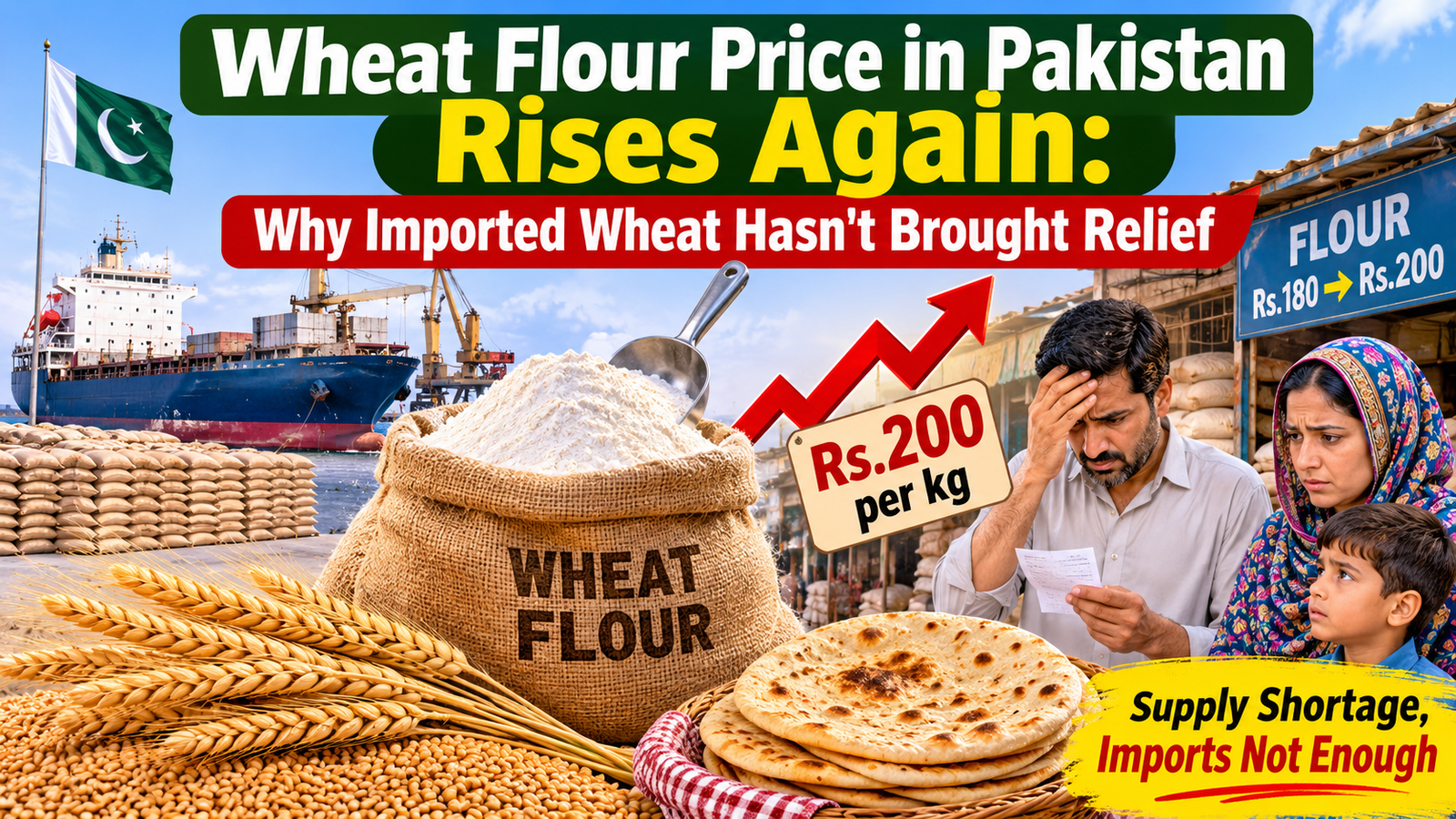
Wheat Flour Price in Pakistan Rises Again: Why Imported Wheat Hasn’t Brought Relief
Walk into almost any neighbourhood shop in Karachi today and you will notice the same thing: the wheat flour price in Pakistan is climbing again, even though shiploads of imported wheat have started arriving at the port. Many households expected the first shipments to cool the market. For a short time they did. Then the relief faded.
For families on low and middle incomes, flour is not a discretionary purchase. It becomes chapati, naan, and paratha, and a Rs10 increase per kilogram adds up quickly across a month. Understanding why prices are rising despite imports can help readers plan their household budgets, and it helps small businesses like tandoors and bakeries anticipate what comes next.
This article explains what has happened to wheat and flour rates in recent weeks, why imports have not stabilised the market, how large the supply gap may be, and what traders, millers, and industry representatives are saying. The figures come from a Dawn news report on the Karachi market. Where numbers are estimates or opinions rather than confirmed data, we say so.
Table of Contents
- Overview: What Is Happening to Wheat and Flour Prices?
- Latest Price Movements at a Glance
- Why Imported Wheat Has Not Brought Relief
- The Supply and Demand Gap Explained
- What Industry Stakeholders Are Saying
- How Rising Flour Prices Affect Households and Tandoors
- Hoarding, Monitoring, and the Role of Authorities
- Practical Tips for Consumers and Small Businesses
- Common Mistakes to Avoid
- Frequently Asked Questions
- Conclusion, Summary
Overview: What Is Happening to Wheat and Flour Prices?
In short, wheat and flour prices in Karachi are rising again after a brief dip, because imported supplies so far appear too small to offset a broader domestic shortage.
Quick Answer
Why are flour prices rising in Pakistan despite wheat imports? Based on the Karachi market report, there are three main reasons. The quantity imported so far is small relative to national demand. Supply from Punjab into Sindh has reportedly slowed. And millers are adjusting rates according to their own stocks, with little coordinated oversight. Stakeholders also point to concerns about hoarding.
Key Highlights
- Retail flour rates have increased. Flour No. 2.5 and fine flour reached Rs180 and Rs200 per kg respectively, up Rs10 per kg, according to retailers, who cited higher rates from millers.
- Imports have started but remain limited. More than 100,000 tonnes of wheat have arrived since the last week of October.
- The grain price dipped, then recovered. Wheat fell from Rs140 to Rs130 per kg after the first ship arrived on October 28, then returned to Rs140 per kg last week.
- A shortage is widely expected. Stakeholders estimate a shortfall of 3 to 4 million tonnes this season.
- The next crop is months away. The new crop from Sindh and Punjab is expected to reach markets between March and May next year.
Latest Price Movements at a Glance
Prices in a commodity market rarely move in one direction for long. The pattern here shows how sensitive the market is to news, expectations, and stock levels.
The Wheat Grain Swing
Before the first import shipment, the open-market wheat rate stood at about Rs140 per kg. When the first vessel, carrying 51,000 tonnes, arrived on October 28, the rate dropped to Rs130. That was a clear sign that the market responds quickly to the expectation of more supply.
The relief did not last. Last week, the open market saw grain prices revert to Rs140 per kg. That reversal forced millers to raise flour prices across different varieties.
Retail Flour Rates
According to the report, retailers raised the rates of flour No. 2.5 and fine flour to Rs180 and Rs200 per kg, an increase of Rs10 per kg. They said they were passing on increases announced by millers.
High-quality chakki flour is selling at about Rs200 per kg in the wholesale market, while retailers are charging Rs215 per kg.
Wholesale Bag Rates
The wholesaler quoted in the report said millers had raised the prices of three varieties per 50kg bag. The table below shows the old and new rates, along with the per-kilogram equivalents (calculated by dividing the bag price by 50).
| Flour Variety | Previous Rate (50kg bag) | New Rate (50kg bag) | Increase per Bag | Approx. New Rate per kg |
|---|---|---|---|---|
| Flour No. 2.5 | Rs7,800 | Rs8,100 | Rs300 | Rs162 |
| Maida | Rs8,400 | Rs9,000 | Rs600 | Rs180 |
| Fine Flour | Rs8,550 | Rs9,150 | Rs600 | Rs183 |
Note: Per-kg figures are simple arithmetic conversions of the reported bag prices, provided for comparison. Actual retail rates vary by shop, area, and brand.
A Pattern of Rise, Dip, and Rebound
The report adds that millers had earlier raised the prices of different varieties by Rs20 per kg. They later began reducing rates ahead of the arrival of imported wheat. Once the dip faded, they raised prices again. This rise-fall-rise pattern is typical of a market in which supply is uncertain and buyers and sellers are guessing what comes next.
Why Imported Wheat Has Not Brought Relief
It is natural to assume that imports should lower prices. Yet several factors described by traders and millers explain why that has not happened so far.
Is the Imported Quantity Large Enough?
More than 100,000 tonnes have arrived since the last week of October. That sounds large, but the scale of national demand is far greater. One miller quoted in the report said that imported wheat would prove highly insufficient, and gave a concrete example: Karachi’s mills alone require 80,000 bags of 100kg each day for grinding.
Using that figure, daily requirements for Karachi mills alone would be roughly 8,000 tonnes. At that rate, 100,000 tonnes would cover about 12 to 13 days of Karachi’s milling demand if nothing else were available. This is our own arithmetic based on the miller’s claim, not an official figure, but it illustrates why traders view the arrivals as a modest cushion rather than a solution.
Sindh Is Waiting, and Punjab Supply Has Slowed
According to the wholesaler quoted in the report, one major reason for rising prices in Karachi is that Sindh has been waiting for imported wheat while arrivals from Punjab have stopped. With less domestic wheat reaching Karachi, millers face a shortage of grain in the open market.
That makes the imported shipments more important locally, but they have to be unloaded, distributed, and milled before they affect shelf prices. In the meantime, scarcity in the open market pushes grain rates upward.
Prices Have Also Risen Elsewhere
An unnamed miller described the situation as alarming. According to him, prices have shot up in Punjab and Khyber Pakhtunkhwa as well, despite the arrival of imported wheat. If accurate, this suggests the pressure is national rather than limited to one city.
No Uniform Flour Rates
The same miller claimed that there are no uniform flour rates across the entire mill community. Each mill sets rates according to its own wheat stocks and its reading of the market. For consumers, this means prices can differ noticeably between brands and areas. For retailers, it means that even a small change in what a miller charges is quickly passed along.
The wholesaler echoed a related concern, saying millers began giving price shocks to consumers again amid the absence of any vigilance by the authorities. These are the stakeholders’ views, and the report does not include a response from the government or millers’ associations on this point.
The Supply and Demand Gap Explained
Understanding the numbers helps separate what is confirmed from what is estimated.
What the Official Production Data Says
The Economic Survey FY26 reports that wheat production rose 4.3 percent to 29.61 million tonnes in FY26, up from 28.40 million tonnes in the preceding year. On paper, that is a healthy improvement. The crisis, therefore, is not a case of a collapsing harvest.
What Demand Estimates Say
Cereal Association of Pakistan (CAP) Chairman Muzammil Chappal said annual wheat demand ranges between 31 million and 32 million tonnes. He argued that the government needs to recognise that demand keeps rising as the population grows, a rate he put at over 3 percent a year.
Taking the official production figure and the CAP’s demand range at face value, the gap would be roughly 1.4 to 2.4 million tonnes. That is real, but smaller than the 3 to 4 million tonnes that stakeholders estimate.
Why Do Shortage Estimates Differ?
The report does not explain the difference, and readers should treat all of these numbers as estimates. Possible reasons include differences in how stocks are counted, how much grain is lost or diverted, and whether estimates account for months when the market is thin before the new crop arrives. We cannot confirm any single explanation from the available information.
What can be said is this: stakeholders agree there is a shortfall, they disagree about its precise size, and official confirmation of the final gap would help the market plan better.
The Timing Problem
Even if the gap is at the lower end, timing matters. Wholesaler Rauf Ibrahim noted that the new crop from Sindh and Punjab will enter markets between March and May next year. Until then, the country must rely on existing stocks and imports. That is why traders say that at least 3 million tonnes are needed to bridge the months ahead.
What Industry Stakeholders Are Saying
Three voices in the report offer different views on the crisis.
The Cereal Association of Pakistan
Muzammil Chappal told Dawn that he had been urging the government since May about a possible shortage of four million tonnes this season. He said he had also asked that the private sector be allowed to import at least 2 million tonnes, but the government did not pay heed. This is the association’s account; the report does not carry an official government response.
The Wholesaler and Trader
Rauf Ibrahim said the country needs at least 3 million tonnes of wheat. He raised three main concerns:
- Weak action against hoarding. He said federal and provincial governments have not launched an effective campaign against hoarders and stock pilferers since the wheat crop hit the markets in FY26.
- Speculation. He said speculators and investors have been active in commodity investing, and urged authorities to check stocks of wheat in markets and godowns.
- Miller stocks. He urged the government to check the stocks of flour millers, who usually keep one to two months’ stocks of grain.
He also warned that the governments had yet to wake up to the shortage, which is hurting low- and middle-income groups hard.
The Millers
An unnamed miller described the situation as alarming and said imported wheat would not be enough. His claim that mills set prices individually suggests that consumers should expect uneven rates until supply stabilises. Because he asked not to be named, his claims cannot be independently attributed, and readers should weigh them accordingly.
How Rising Flour Prices Affect Households and Tandoors
Flour is the backbone of the Pakistani kitchen. When its price moves, almost everything on the dining table is affected, from the daily roti to the street-side naan. The impact is not equal across income groups, which is why the report’s warning about low- and middle-income families deserves attention.
The Household Budget Effect
A Rs10 per kg rise looks small in isolation. Over a month, it is not. Consider a simple illustration (our own arithmetic, not data from the report): a household that uses 20 kg of flour a month would pay about Rs200 more for the same quantity after a Rs10 rise. A larger family using 40 kg would pay about Rs400 more. Those amounts matter most to families that already spend a large share of their income on food.
Wholesaler Rauf Ibrahim put the concern in stark terms, saying consumers would shudder at the thought of paying Rs2,000 for a 10kg flour bag. That figure equals Rs200 per kg, which is exactly where fine flour and high-quality chakki flour are already priced in some markets. It is a warning about what the next step up might look like, not a confirmed rate for every shop.
Why Choice of Flour Variety Matters
The report shows a spread in prices between varieties. Flour No. 2.5 is the lowest-priced of those listed, while fine flour and chakki flour sit higher. Households that have switched to finer varieties for taste may find that going back to a standard variety softens the monthly bill. That is a practical option, not a recommendation about nutrition or preference.
Tandoors Under Double Pressure
Tandoor owners face what the report calls a fix: high rates for both flour and LPG. Their costs are rising on two fronts, yet they have so far kept prices unchanged. The reported prices are:
| Item | Reported Price |
|---|---|
| Chapati | Rs20 |
| Naan | Rs30–35 |
| Sheermal / Taftaan | Rs100–110 |
| Qulcha | Rs90–100 |
Holding prices while costs rise squeezes margins. If flour and LPG stay high, owners may eventually have to raise prices, reduce weight, or both. The report does not say whether any tandoors plan to do so, so this is a possibility rather than a forecast.
Who Is Most Exposed?
Based on the report’s description, the groups under the most pressure are:
- Low-income households, for whom flour is the main staple.
- Middle-income families, whose budgets are squeezed by other costs.
- Small food businesses, such as tandoors, with limited ability to pass on costs.
Hoarding, Monitoring, and the Role of Authorities
Stakeholders repeatedly return to one theme: oversight. This section sets out what they said and what remains unconfirmed.
What Is Being Alleged
Ibrahim said federal and provincial governments have not launched an effective campaign against hoarders and stock pilferers since the wheat crop hit the markets in FY26. He also said speculators and investors have been active in commodity investing. The report presents these as his views. It does not provide evidence of specific hoarding cases, and we cannot confirm them.
What Stakeholders Want Authorities to Do
Based on the report, stakeholders are asking for:
- Stock checks in markets and godowns, especially for wheat.
- Verification of miller stocks, since millers typically hold one to two months of grain.
- Faster action on imports, including, in the CAP’s view, allowing the private sector to import at least 2 million tonnes.
- Monitoring of flour rates, given that mills currently set prices independently.
The Other Side of the Argument
A balanced reading needs to acknowledge that the report does not include comments from government officials or millers’ associations. Authorities may have reasons for their import timing and enforcement approach, such as budget limits, logistics, or estimates of available stocks. Without their response, readers should see these as one side of an unresolved debate.
Why Price Controls and Checks Are Hard
Even when authorities do act, monitoring a grain market is difficult. Stocks are spread across farms, godowns, and mills, and wheat moves between provinces. Enforcement also has to avoid disrupting legitimate storage, since millers and traders normally hold stocks for business reasons. This is general context, not a claim from the report.
Practical Tips for Consumers and Small Businesses
None of the following can lower national prices, but they can help you manage the effect on your own budget. These are general suggestions rather than financial or nutritional advice.
Tips for Households
- Compare shops before buying. The report says mills set rates individually, so prices can vary between brands and retailers.
- Check the variety. Standard flour is priced lower than fine flour and chakki flour in the quoted rates.
- Buy in sensible quantities. Buying a month’s supply can help if prices are rising, but only buy what you can store properly and use. Panic buying can push prices up further.
- Store flour correctly. Keep it in a clean, dry, airtight container to avoid moisture and pests.
- Reduce waste. Plan roti quantities to match the family’s actual needs.
- Track prices weekly. Keeping a simple note of rates helps you spot a real trend rather than reacting to one shop’s price.
Tips for Tandoors and Small Food Businesses
- Monitor LPG and flour costs together. Both feed into your cost per piece.
- Calculate cost per item. Knowing your margin on chapati versus naan versus sheermal shows where the pressure is greatest.
- Consider gradual adjustments. If you must raise prices, a small, clearly communicated change may be better received than a sudden jump. This is a general business suggestion, not a prediction about customers.
- Talk to suppliers. Regular buyers may be able to discuss delivery timing or bulk arrangements.
What to Watch in the Coming Weeks
- Further import arrivals and their size.
- Whether open-market grain rates stay at Rs140 per kg or move.
- Whether supply from Punjab to Sindh resumes.
- Any announcement from authorities on stock checks or additional imports.
- The timing of the new crop, expected between March and May next year.
Common Mistakes to Avoid
Assuming Imports Mean Instant Relief
The October 28 dip showed that markets react to arrivals, but the rebound shows that one or two shipments may not be enough. Households should not assume prices will fall quickly.
Panic Buying and Over-Stocking
Buying far more than you need can add to demand pressure and leaves you with flour that may spoil. Moderate, steady buying is more sensible.
Relying on Rumours
Prices and shortage claims spread quickly in markets and on social media. Check figures against credible news reports or official statements before acting.
Treating All Estimates as Facts
The shortage estimates here range from roughly 1.4 million tonnes (our arithmetic from the reported production and demand figures) to 3 to 4 million tonnes (stakeholders’ estimates). These are different calculations, not confirmed numbers.
Ignoring Smaller Cost Increases
Small increases compound. A Rs10 rise per kg, applied month after month, becomes a significant expense.
Pros and Cons of Relying on Imported Wheat
| Aspect | Potential Benefits | Potential Limitations |
|---|---|---|
| Supply | Adds grain to a market facing a shortfall | Quantities so far are small relative to demand |
| Price | Triggered a short-lived dip to Rs130 per kg | The dip reversed within weeks |
| Timing | Can fill the gap before the new crop | Logistics and distribution take time |
| Regional impact | Helps Sindh, which has been waiting for supply | Prices have also risen in Punjab and Khyber Pakhtunkhwa, per the miller |
This table summarises the report’s information and general market logic; it is not an economic forecast.
Frequently Asked Questions
Why are flour prices rising in Pakistan even after wheat imports?
According to the report, imported quantities so far are modest compared with demand, Punjab’s supply to Sindh has slowed, and millers are setting prices according to their own stocks. Stakeholders also cite weak oversight and speculation, though these are their claims.
How much wheat has been imported so far?
More than 100,000 tonnes have arrived since the last week of October, beginning with a ship carrying 51,000 tonnes on October 28.
How big is Pakistan’s wheat shortage?
There is no single confirmed figure. Stakeholders estimate 3 to 4 million tonnes. The official FY26 production figure is 29.61 million tonnes, and the CAP puts annual demand at 31 to 32 million tonnes, which implies a smaller gap by simple subtraction. Treat all numbers as estimates.
When might prices ease?
The report does not predict a date. It notes that the new crop from Sindh and Punjab is expected between March and May next year. Prices before then will likely depend on imports, stock movements, and enforcement.
Have tandoor prices gone up?
According to the report, not yet. Chapati remains Rs20 and naan Rs30–35, though owners face higher flour and LPG costs.
Conclusion
The rise in the wheat flour price in Pakistan is a reminder that a harvest figure alone does not guarantee stable prices. Production grew 4.3 percent to 29.61 million tonnes in FY26, yet demand, population growth, timing, and supply-chain gaps have left the market tight. Imports have begun, and the brief drop to Rs130 per kg showed they can help, but the quantities so far appear small compared with what traders say is needed.
For consumers, the sensible response is calm and practical: compare prices, buy reasonably, and avoid rumours. For tandoors and small businesses, tracking costs closely is essential. For policymakers, stakeholders have laid out clear requests around stock checks, import decisions, and market monitoring, though the government’s perspective is not in the report.
Much depends on how quickly supplies arrive and how the market behaves until the new crop in March to May. Readers should follow credible updates, since this situation may change.
Summary
Wheat and flour prices in Karachi are rising again despite more than 100,000 tonnes of imported wheat arriving since late October. Grain briefly fell to Rs130 per kg before returning to Rs140, pushing flour No. 2.5 and fine flour to Rs180 and Rs200 per kg at retail. Stakeholders estimate a shortage of 3 to 4 million tonnes, though official production was 29.61 million tonnes in FY26. Traders cite slow Punjab supply, uneven mill pricing, and weak oversight. Tandoors face higher flour and LPG costs but have not yet changed prices. Households can manage by comparing prices and buying sensibly.