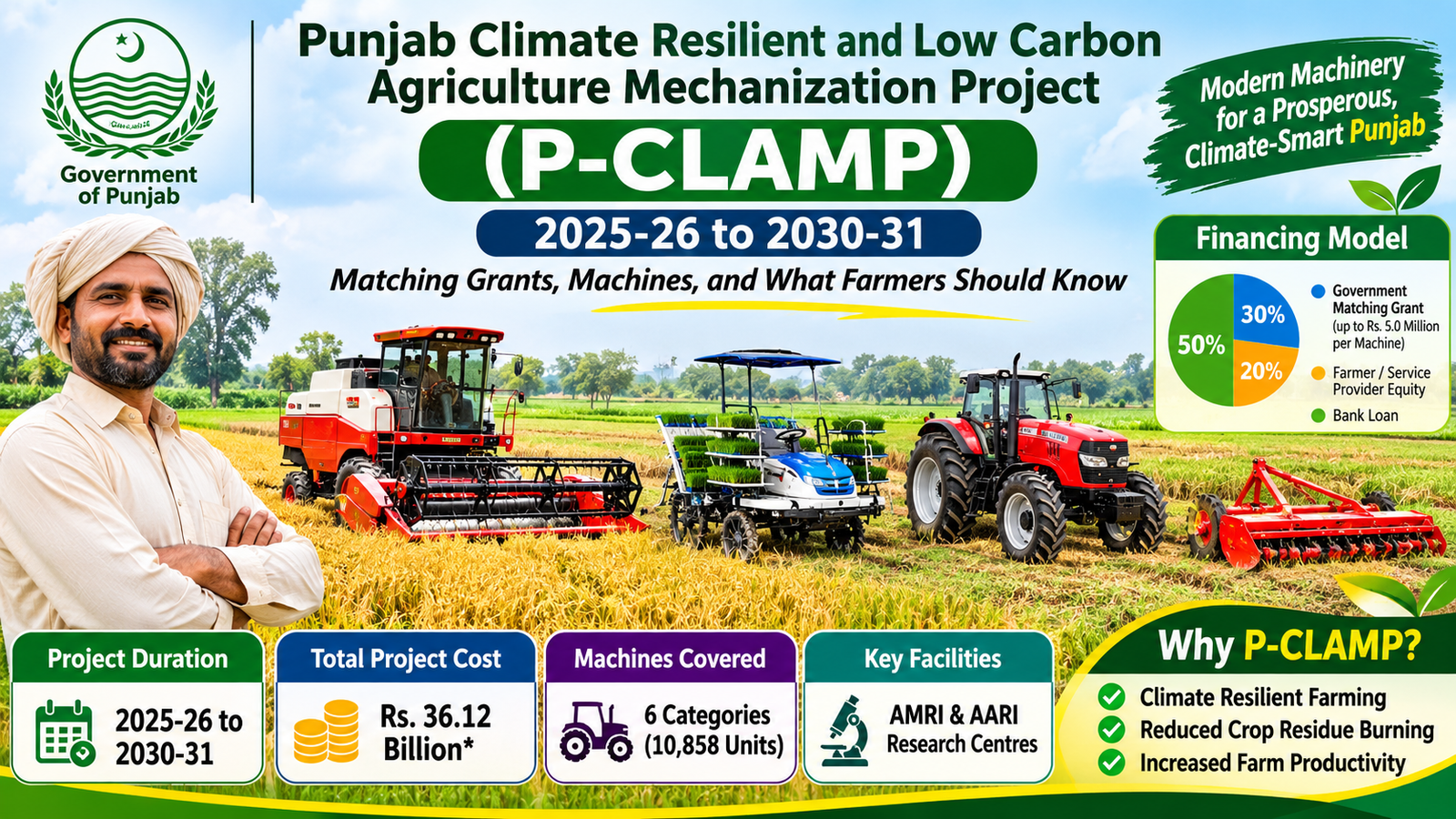
Punjab Climate Resilient and Low Carbon Agriculture Mechanization Project (P-CLAMP) 2025-26 to 2030-31: Matching Grants, Machines, and What Farmers Should Know
Introduction
Farmers in Punjab face rising input costs, labour shortages at peak sowing and harvesting times, and growing pressure to reduce crop residue burning. Modern machinery can help with all three, but a rice combine harvester or a riding-type transplanter costs far more than most small and mid-sized operators can pay upfront.
The Punjab Climate Resilient and Low Carbon Agriculture Mechanization Project (P-CLAMP) is designed to address that gap. Planned for 2025-26 to 2030-31, it combines a government matching grant, farmer or service provider equity, and bank financing to put thousands of machines into the field. It also includes two research and testing facilities.
This article explains what P-CLAMP is, how the 30/20/50 financing model works, which machines are covered and how many of each, and why the project matters for climate-smart farming in Punjab. Details here come from the project’s published summary. Eligibility rules, application procedures, and timelines can change, so confirm them with the Punjab Agriculture Department before acting.
Table of Contents
- What Is P-CLAMP? (Overview)
- P-CLAMP at a Glance: Key Highlights
- How Does the P-CLAMP Financing Model Work?
- Which Machines Does P-CLAMP Cover?
- Why Mechanization Matters for Climate Resilience in Punjab
- Supporting Infrastructure: AMRI and AARI Facilities
- Benefits, Practical Guidance, Pros and Cons, and FAQs
What Is P-CLAMP? (Overview)
P-CLAMP is a multi-year agricultural mechanization programme for Punjab, running from 2025-26 to 2030-31. “Climate resilient” and “low carbon” in the name signal its two goals: helping farming systems cope with climate pressures such as heat stress, water scarcity, and erratic weather, and reducing the emissions linked to traditional practices like open-field residue burning.
Its main tool is machinery access. Instead of distributing equipment for free, the project uses a cost-sharing approach in which the government covers part of the price, the buyer invests their own money, and a bank provides the remainder as a loan. This makes machine ownership possible for people who could not otherwise finance it, while still requiring the buyer to have a real stake in the investment.
The project has three parts:
- A machinery support component that subsidises purchases of six categories of agricultural machines.
- A Machinery Testing & Evaluation Centre at the Agricultural Mechanization Research Institute (AMRI), Faisalabad.
- A Speed Breeding Facility at the Ayub Agricultural Research Institute (AARI).
P-CLAMP at a Glance: Key Highlights
| Feature | Detail |
|---|---|
| Project name | Punjab Climate Resilient and Low Carbon Agriculture Mechanization Project (P-CLAMP) |
| Duration | 2025-26 to 2030-31 |
| Total project cost | 36,120.000 (as listed in the source summary) |
| Allocation for 2025-26 | 3,400.000 (as listed in the source summary) |
| Government grant | 30% matching grant per machine, up to Rs. 5.0 million per machine |
| Farmer / service provider equity | 20% |
| Bank financing | 50% loan |
| Machines covered | 6 categories, 10,858 units in total |
| Research components | Testing & Evaluation Centre (AMRI, Faisalabad); Speed Breeding Facility (AARI) |
A note on the figures. The source lists the total cost as 36,120.000 and the current-year allocation as 3,400.000 without a currency unit. In Pakistani development documents such figures are normally expressed in Rs. million, which would mean about Rs. 36.12 billion in total and Rs. 3.4 billion for 2025-26. That is an inference, not a confirmed fact, so check the official document before quoting the amounts.
The 10,858 total is the sum of the unit targets listed for each machine category, covered later in this article.
How Does the P-CLAMP Financing Model Work?
Under P-CLAMP, the price of each eligible machine is divided into three shares:
- 30% from the government as a matching grant, capped at Rs. 5.0 million per machine.
- 20% from the farmer or service provider as equity, meaning their own contribution.
- 50% from a bank as a loan.
What does “matching grant” mean?
A matching grant is a subsidy that is paid only when the buyer also puts in their own money and secures financing. The government does not hand over a machine or cash outright. Its contribution is tied to the buyer’s own investment, which tends to encourage careful purchasing and responsible use.
An illustrative example
The following is a hypothetical calculation to show how the percentages work, not an official price or approved case. Suppose a machine costs Rs. 10 million:
| Share | Percentage | Amount |
|---|---|---|
| Government matching grant | 30% | Rs. 3.0 million |
| Buyer’s equity | 20% | Rs. 2.0 million |
| Bank loan | 50% | Rs. 5.0 million |
At 30%, the grant reaches the Rs. 5.0 million cap only when a machine costs roughly Rs. 16.7 million. For machines priced above that, the cap would limit the subsidy, and the buyer or lender would cover the rest. Actual machine prices, the approved price basis, and the exact rules for applying the cap should be confirmed with the implementing department.
Who are the beneficiaries?
The source names farmers and service providers. Service providers are typically entrepreneurs who own expensive machines and rent them out to other farmers per acre or per hour. This model matters because most smallholders cannot justify buying a combine harvester for their own few acres. Renting from a nearby service provider gives them access to mechanization without the capital burden.
What to verify before applying
The summary does not spell out several practical details. Before planning an investment, confirm:
- The exact eligibility criteria for farmers and service providers.
- Which banks participate and what loan terms and interest or markup rates apply.
- Whether the grant is paid upfront, reimbursed after purchase, or adjusted in some other way.
- Which machine brands, models, and specifications are approved.
- Application windows, documentation requirements, and selection methods.
Because these rules can change, rely on official notices from the Punjab Agriculture Department rather than third-party summaries, including this one.
Which Machines Does P-CLAMP Cover?
The project lists six categories of machinery with specific unit targets. These cover the main labour- and time-intensive stages of rice and wheat production: transplanting, harvesting, and residue handling.
| Machine | Target units |
|---|---|
| Head / Half-Feed Rice Combine Harvesters | 3,050 |
| Full-Feed Rice-Wheat Combine Harvesters | 1,052 |
| Rice Transplanters (Riding Type) | 800 |
| Rice Transplanters (Walk-Behind) | 4,000 |
| Rice Nursery Raising Machines | 1,506 |
| Balers for Crop Residue Management | 450 |
| Total | 10,858 |
Head / Half-Feed Rice Combine Harvesters (3,050 units)
A combine harvester cuts, threshes, and cleans the crop in one pass. Head-feed (half-feed) types are commonly associated with rice, where only the grain-bearing heads of the plant enter the threshing drum and the rest of the straw remains in the field. They generally suit paddy harvesting. They also account for the second-largest allocation in the project, a sign of how much weight it places on rice harvest mechanization.
Full-Feed Rice-Wheat Combine Harvesters (1,052 units)
Full-feed combines draw the whole cut plant into the threshing system. As the name suggests, this category is intended for both rice and wheat, which gives owners more working days per year. A machine that works in both seasons earns income for longer, which can make loan repayment easier for service providers.
Rice Transplanters, Riding Type (800 units)
Riding-type transplanters carry the operator while planting rice seedlings in uniform rows. They cover more acres per day than walk-behind models and are generally more suitable for larger holdings or custom-hire businesses. The relatively smaller target of 800 units probably reflects their higher price and larger working scale.
Rice Transplanters, Walk-Behind (4,000 units)
Walk-behind transplanters are operated on foot and are lighter and cheaper. They fit smaller fields and smaller budgets, which is likely why this category has the largest target of all, at 4,000 units. Manual transplanting is labour-intensive and depends on seasonal workers, so a machine that plants in even rows can reduce dependence on scarce labour at a critical time.
Rice Nursery Raising Machines (1,506 units)
Mechanical transplanters need seedlings grown in a specific format, usually uniform trays or mats, rather than the traditional nursery beds. Nursery raising machines help prepare these seedlings. Including them in the project suggests the programme treats mechanized rice establishment as a connected system rather than a single machine purchase. A transplanter without suitable seedlings cannot work properly.
Balers for Crop Residue Management (450 units)
Balers collect loose straw and compress it into compact bales that can be removed from the field. They are central to the project’s low-carbon objective, because bales give farmers an alternative to burning residue. Bales can potentially be used or sold for purposes such as livestock fodder, bedding, or energy, depending on local markets. That market is a practical question each prospective buyer should check before investing.
Why Mechanization Matters for Climate Resilience in Punjab
Punjab is Pakistan’s most important agricultural province, and its rice-wheat rotation shapes both food supply and rural livelihoods. Mechanization touches that system in several ways.
Timeliness
Crop yields are sensitive to timing. Transplanting rice late, or delaying wheat sowing after a slow rice harvest, can reduce production. Faster harvesting and transplanting shorten these windows. This is also why harvesting machinery and wheat-sowing practices are connected: when rice is cleared promptly, the next crop can be planted sooner.
Labour constraints
Farm labour is not always available at peak periods, and wages rise sharply when many farmers need workers at once. Machines reduce reliance on that seasonal labour pool, though they also change the nature of rural employment, which is worth acknowledging honestly.
Residue management and air quality
Burning crop stubble is widely recognised as a contributor to seasonal smog and air pollution in South Asia. Where farmers burn residue because it is the quickest option before the next sowing, balers and better-matched harvesting equipment offer alternatives. The project’s “low carbon” label points to this purpose, though the actual emissions reduction will depend on how widely the machines are used and what happens to the baled residue.
Efficiency and resource use
Uniform transplanting and well-timed operations can support more efficient use of seed, labour, and irrigation. The size of these gains varies by farm, soil, and management, so claims of specific savings should be treated cautiously unless they come from field trials.
Supporting Infrastructure: AMRI and AARI Facilities
P-CLAMP is not only a subsidy scheme. It also funds two institutional facilities.
Machinery Testing & Evaluation Centre at AMRI, Faisalabad
A testing and evaluation centre checks whether agricultural machines perform as claimed, whether they are safe, and whether they suit local conditions. This matters for a subsidy programme. When public money helps pay for machines, buyers benefit from standards that separate reliable equipment from poor-quality products. Faisalabad is also home to major agricultural institutions, which makes AMRI a logical location for such a facility.
Speed Breeding Facility at AARI
Speed breeding is a technique that shortens crop generation time by manipulating growing conditions such as light and temperature. This lets researchers move through breeding cycles faster than conventional field seasons allow. In a climate resilience context, that can help develop crop varieties adapted to heat, disease, or other stresses sooner. The source gives no details of the facility’s capacity or crop focus, so those remain to be confirmed.
Taken together, the two facilities show the project aims to improve both the tools farmers use and the varieties they grow.
Benefits and Features of P-CLAMP
The project’s design points to several benefits for different groups. These are intended outcomes based on the project’s structure. Actual results will depend on implementation and on how each buyer uses the machine.
For farmers and service providers
- Lower upfront burden. With 30% covered by the grant and 50% by a bank loan, the buyer’s own cash requirement is 20% of the machine price.
- Wider access to equipment. Service providers who buy machines can rent them to neighbours, so even farmers who never buy anything can use mechanization.
- A connected set of machines. Nursery raising machines, transplanters, combines, and balers cover the cycle from seedling preparation to residue handling.
For the wider farming system
- Quality assurance. The AMRI testing centre can support performance and safety checks on machinery.
- Research capacity. The AARI speed breeding facility can help shorten the time needed to develop improved crop varieties.
- Environmental goals. Balers and timely harvesting offer alternatives to open burning of residue.
Step-by-Step: How to Plan a Machine Purchase Under P-CLAMP
The summary does not publish an application procedure, so the steps below are a practical planning framework, not the official process. Follow official guidance wherever it differs.
Step 1: Confirm eligibility and current notices
Check the Punjab Agriculture Department’s official channels for the latest announcements, eligibility rules, and application windows. Rely on official notices rather than social media posts or agents.
Step 2: Decide which machine fits your operation
Match the machine to your acreage and business model. A farmer with a few acres of paddy has very different needs from a service provider who plans to serve a whole village.
Step 3: Estimate your own costs and income
Work out the following before committing:
- The machine’s expected price and your 20% equity share.
- The loan amount (50%) and the repayment burden once terms are known.
- Fuel, operator wages, maintenance, repairs, insurance, and storage.
- Realistic annual working days and the rate you can charge per acre or hour.
Step 4: Talk to a participating bank
Ask about markup or interest rates, repayment period, collateral or guarantee requirements, and documentation. Loan terms are not stated in the project summary, so do not assume them.
Step 5: Choose machines carefully
Ask whether the model is approved under the scheme, what warranty it carries, and whether spare parts and trained mechanics are available locally. Where testing results exist, check them.
Step 6: Plan for operator training and maintenance
A machine idles without a skilled operator. Budget time for training and a maintenance schedule before the busy season starts.
Choosing Between Machine Types: A Quick Comparison
| Factor | Walk-Behind Transplanter | Riding-Type Transplanter | Rice Combine Harvester |
|---|---|---|---|
| Typical user | Small and mid-sized farms | Larger farms, service providers | Service providers, larger farms |
| Target units in P-CLAMP | 4,000 | 800 | 3,050 (head-feed) + 1,052 (full-feed) |
| Relative cost | Lower | Higher | Highest |
| Main advantage | Affordable, suits small plots | Faster coverage per day | Cuts, threshes, and cleans in one pass |
| Main consideration | Slower, needs more operator effort | Needs larger fields and more capital | Needs enough working days to repay the loan |
The relative-cost row reflects general market patterns. Exact prices depend on brand, specifications, and the year of purchase.
Practical Tips for Prospective Applicants
- Think in seasons, not years. Rice transplanting and harvesting happen in short windows. Make sure your machine is delivered, serviced, and operator-ready before the season begins.
- Consider a shared or service-provider model. If your own land cannot keep a machine busy, a business that serves several farms may repay a loan more comfortably than a single-farm purchase.
- Line up demand early. Service providers can talk to neighbouring farmers ahead of time to estimate how many acres they could realistically serve.
- Match the whole system. A transplanter needs suitable seedlings, and a baler needs a plan for where the bales will go. Check the connected pieces first.
- Keep clear records. Receipts, quotations, bank documents, and work logs will help with both loan servicing and any verification the scheme requires.
- Test the market for bales. If you plan to buy a baler, find out who buys straw bales locally and at what price before you invest.
Common Mistakes to Avoid
- Buying on the grant alone. A subsidy lowers the price, but the machine still has to earn enough to cover the loan and running costs.
- Ignoring operating costs. Fuel, wages, repairs, and downtime can erode returns if they are not budgeted.
- Over-sizing the purchase. A large machine on small, fragmented holdings can be inefficient.
- Skipping the fine print. Loan conditions, repayment schedules, and grant payment mechanics matter as much as the headline 30/20/50 split.
- Neglecting maintenance. Poorly maintained machines lose value and fail at critical moments.
- Relying on informal middlemen. Confirm information directly with official offices to avoid misinformation or unauthorised charges.
Pros and Cons
| Pros | Cons and Limitations |
|---|---|
| 30% matching grant reduces the purchase price | Buyer must still arrange 20% equity |
| Bank financing spreads the cost over time | Loan repayment is a firm obligation, regardless of harvest outcomes |
| Wide machine range supports rice and wheat operations | Source summary does not state eligibility, loan terms, or timelines |
| Baler support offers an alternative to residue burning | Bale demand and prices vary by area |
| Testing centre can improve equipment quality | Impact depends on implementation and uptake |
| Speed breeding can accelerate variety development | Capacity and crop focus not specified in the summary |
Who Should Consider P-CLAMP, and Who Should Think Twice?
Who may benefit
- Service providers and agricultural entrepreneurs with the skills and market access to keep machines busy across seasons.
- Progressive farmers with larger holdings who can use a machine intensively on their own land.
- Groups or cooperatives, if the scheme’s rules allow, who may pool equity and share a machine.
Who should be cautious
- Applicants with no clear plan for repayment. A loan taken for a machine that does not earn enough can become a burden.
- Very small farmers with only a few acres who would likely do better renting machine services than owning a machine.
- Anyone unable to maintain or operate the equipment safely and skillfully.
This is general guidance, not financial advice. Consider talking to a bank officer or agricultural extension officer about your own situation.
Real-World Context
Rather than invent a case study, it is worth being honest: the project covers 2025-26 to 2030-31, and no verified field results from P-CLAMP itself are cited here. Readers looking for evidence of impact should check official progress reports, evaluations, and independent research as they are published. Likewise, claims about yield gains or cost savings from mechanization should come from trial data, not marketing material.
Frequently Asked Questions
What does P-CLAMP stand for?
P-CLAMP stands for the Punjab Climate Resilient and Low Carbon Agriculture Mechanization Project. It runs from 2025-26 to 2030-31.
How much grant does P-CLAMP provide per machine?
The project provides a 30% matching grant per machine, with a maximum of Rs. 5.0 million per machine. The farmer or service provider contributes 20% equity, and banks provide 50% as a loan.
Which machines are included in P-CLAMP?
Six categories are listed: head or half-feed rice combine harvesters (3,050 units), full-feed rice-wheat combine harvesters (1,052), riding-type rice transplanters (800), walk-behind rice transplanters (4,000), rice nursery raising machines (1,506), and balers for crop residue management (450).
Where will the testing centre and speed breeding facility be located?
The Machinery Testing & Evaluation Centre is planned at AMRI, Faisalabad. The Speed Breeding Facility is planned at AARI.
Is the grant guaranteed once I apply?
No. Approval depends on the scheme’s eligibility rules, selection process, and available funding. Nothing in the published summary guarantees approval, so verify the procedure with the Punjab Agriculture Department.
Conclusion
P-CLAMP combines three elements: a 30% government matching grant, 20% buyer equity, and 50% bank financing. It targets machines that address real pressure points in Punjab’s rice-wheat system, from transplanting and harvesting to residue handling. With 10,858 machines planned across six categories, plus a testing centre at AMRI and a speed breeding facility at AARI, it treats mechanization as both a field-level and a research-level effort.
The opportunity is real, but so is the responsibility. A machine bought with a loan has to earn its keep. Prospective applicants should confirm eligibility, loan terms, approved models, and timelines through official channels, plan for operating costs, and choose equipment that fits their land and market. Done carefully, mechanization can help farmers save time, manage labour shortages, and reduce reliance on residue burning.
Summary
The Punjab Climate Resilient and Low Carbon Agriculture Mechanization Project (P-CLAMP) runs from 2025-26 to 2030-31. It offers a 30% matching grant per machine, up to Rs. 5.0 million, with 20% buyer equity and 50% bank financing. Six machine categories totalling 10,858 units are planned, including combine harvesters, rice transplanters, nursery raising machines, and balers. The project also includes a Machinery Testing & Evaluation Centre at AMRI, Faisalabad, and a Speed Breeding Facility at AARI. Applicants should verify eligibility, loan terms, and procedures with official sources and plan carefully for repayment and operating costs.
1 thought on “P-CLAMP Punjab 2025-31: Machines, 30% Grant and Financing Guide”