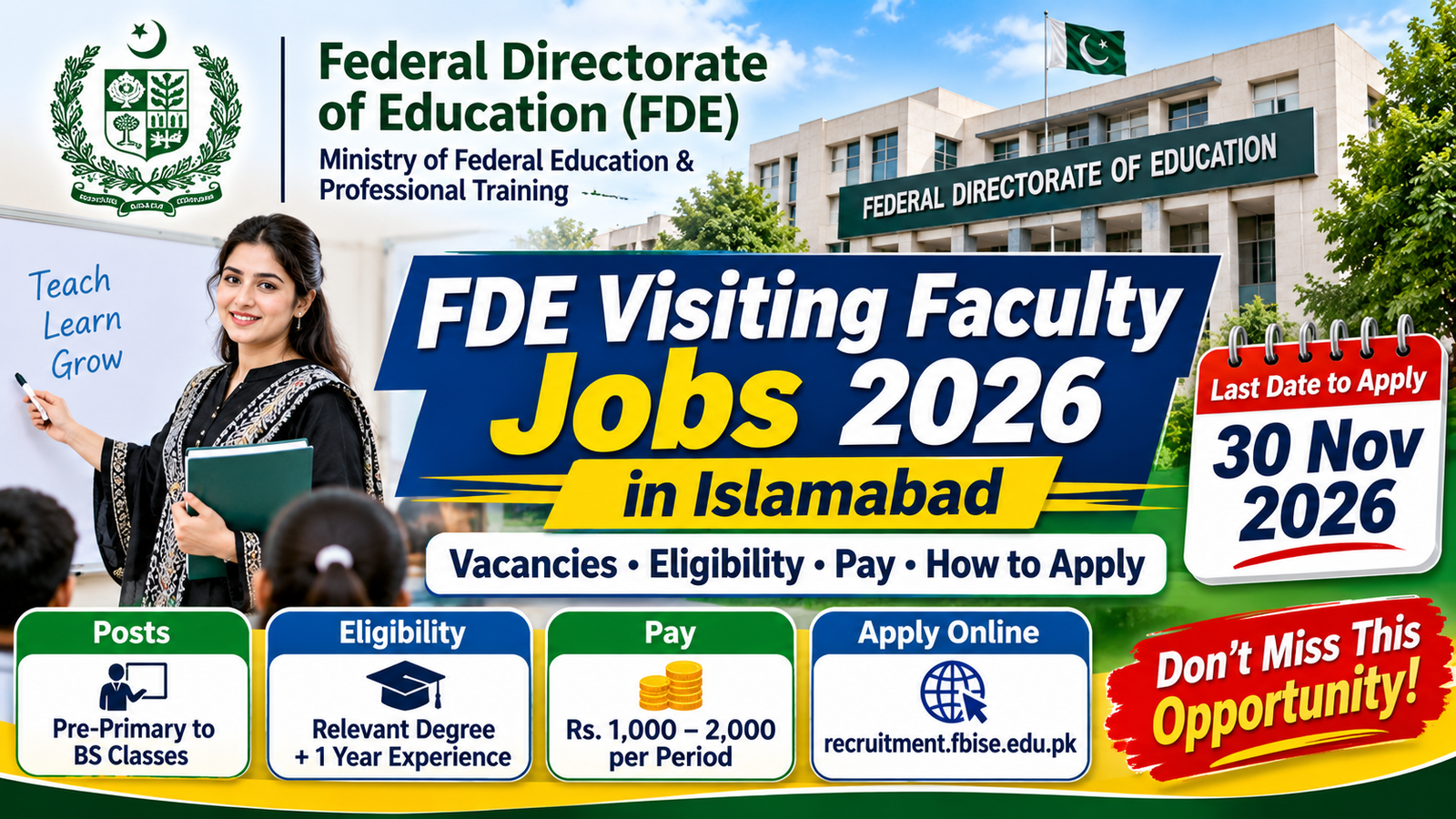
FDE Visiting Faculty Jobs 2026 in Islamabad: Vacancies, Eligibility, Pay and How to Apply
Introduction
If you are a qualified teacher or lecturer looking for work in Islamabad, the Federal Directorate of Education (FDE) has announced a recruitment drive that deserves a close look. Under the Ministry of Federal Education & Professional Training, the FDE has invited applications for visiting faculty positions in its schools and colleges. The posts span pre-primary classes through higher secondary (HSSC) and BS-level classes.
The announcement is packed with numbers, subject lists, pay rates, age limits and conditions, and it is easy to miss something important. Many candidates also confuse a visiting faculty post with a permanent teaching job. The two are very different.
This guide explains the FDE visiting faculty jobs 2026 announcement in plain language. It covers who can apply, which subjects are open, how many seats are listed, how pay works, and which conditions apply to the engagement. Stage 2 will cover the application process, practical preparation tips, common mistakes and frequently asked questions. All details here come from the official advertisement, and anything that is my own calculation is clearly marked as such.
Table of Contents
- Overview: What Is the FDE Visiting Faculty Announcement?
- Key Highlights at a Glance
- What Does “Visiting Faculty” Actually Mean?
- Vacancies and Subjects in Detail
- Pre-Primary to Secondary and HSSC Classes
- BS Classes
- Eligibility Criteria Explained
- Educational Qualification
- Experience Requirement
- Age Limit
- Preference for Daily Wage Teachers
- Remuneration: How Much Will You Earn?
- Workload and Working Conditions
- Important Conditions Every Applicant Should Understand
Overview: What Is the FDE Visiting Faculty Announcement?
The Federal Directorate of Education manages public-sector schools and colleges in the Islamabad Capital Territory. Like many education departments, it sometimes needs extra teaching capacity for a particular session or semester. Instead of creating permanent posts, it engages visiting faculty on a need basis.
The advertisement invites eligible candidates to apply for two broad categories of positions:
- Category A: Pre-primary to Secondary classes and HSSC (Higher Secondary School Certificate) classes.
- Category B: BS (Bachelor of Science) classes at the undergraduate level.
Applications are online only. According to the announcement, no hard copy will be entertained. The last date to apply is 30 November 2026. With the date of this article being 17 November 2026, applicants have roughly two weeks, so it is wise not to leave registration to the final day.
Key Highlights at a Glance
| Detail | Information |
|---|---|
| Organization | Federal Directorate of Education (FDE), Islamabad |
| Parent ministry | Ministry of Federal Education & Professional Training, Government of Pakistan |
| Type of engagement | Visiting faculty, temporary and need-based |
| Levels covered | Pre-primary to Class X/SSC, HSSC, and BS classes |
| Application mode | Online only (no hard copies) |
| Registration portal | recruitment.fbise.edu.pk |
| Last date to apply | 30 November 2026 |
| Maximum age at engagement | 65 years |
| Selection basis | Merit; shortlisted candidates called for test/interview |
| TA/DA | Not admissible |
These points set the tone for the whole announcement. This is a flexible, session-based opportunity, not a regular government appointment.
What Does “Visiting Faculty” Actually Mean?
Before looking at the numbers, it helps to understand what you would be signing up for. A visiting faculty member is engaged to teach a set number of periods. The FDE advertisement describes this engagement as:
- Purely need-based and temporary, limited to a specific session or semester.
- Without any right to permanence or regularization. It does not confer pensionary benefits.
- Not continuing beyond the approved academic session or semester.
- Terminable at any time, depending on requirements.
In practical terms, this is a good fit for people who want teaching experience in a public institution, who are between jobs, or who want flexible work alongside other commitments. It is not a good fit for anyone who needs long-term job security. Anyone applying should read the conditions above carefully, because they define the nature of the arrangement.
Vacancies and Subjects in Detail
The advertisement lists separate male and female requirements for each subject. This is the core of the announcement, and the figures below are taken directly from it.
Pre-Primary to Secondary Classes and HSSC Classes
| Subject | Male | Female |
|---|---|---|
| Education / Psychology / ECE / English / Urdu (for ECE classes) | 0 | 100 |
| Computer Science | 20 | 80 |
| Biology | 5 | 15 |
| Mathematics | 10 | 70 |
| English | 20 | 50 |
| Urdu | 15 | 30 |
| Islamiat | 10 | 10 |
| Pak. Studies | 5 | 15 |
By my own addition of the figures in this table, the advertisement lists 85 positions for male candidates and 370 for female candidates, a total of 455 in this category. Please verify this against the original advertisement, as I have not seen any official total published.
Some patterns stand out:
- Female candidates are in much higher demand. Early childhood education alone needs 100 female visiting faculty members and none for men.
- Computer Science, Mathematics and English are the biggest areas outside ECE, which suggests strong demand for subject specialists in these fields.
- Islamiat has an equal split, with 10 positions each for men and women.
BS Classes
| Subject | Male | Female |
|---|---|---|
| Psychology | 0 | 3 |
| Urdu | 0 | 3 |
| Islamic Studies | 0 | 3 |
The BS category is much smaller, with 9 positions in total, all for female candidates by my count. This is a narrow opportunity, so candidates with an MS/MPhil or PhD in these subjects should apply promptly.
Eligibility Criteria Explained
Eligibility differs between the two categories, so read the section that matches your qualification.
Educational Qualification
For Pre-Primary to Secondary and HSSC classes:
A BS degree or equivalent (16 years of education) in the relevant subject, recognized by the Higher Education Commission (HEC). This applies to primary, secondary and higher secondary levels.
For BS classes:
An MS/MPhil or equivalent (18 years of education) in the relevant subject, recognized by HEC, for BS/ADP-level visiting faculty.
Two points are worth stressing. First, the degree must be in the relevant subject. A degree in an unrelated field is unlikely to meet the requirement. Second, HEC recognition matters. If your degree was earned abroad or at an institution whose status you are unsure about, check its recognition status before you apply.
Experience Requirement
Both categories require a minimum of one year of post-qualification teaching experience. The advertisement makes an exception for PhD degree holders, who are not subject to this requirement.
“Post-qualification” is the key word. Teaching you did while still studying for the required degree may not count. If your experience is borderline, keep your appointment letters, experience certificates and other supporting documents ready, because you will likely need to upload them during registration.
Age Limit
The maximum age is 65 years at the time of engagement. The advertisement does not state a minimum age here, and the notice does not describe any age relaxation. Candidates close to the limit should check their exact age against the engagement date.
Preference for Daily Wage Teachers
The advertisement includes a one-time provision for existing daily wage teachers working in educational institutions under the FDE. They must apply through this same advertisement, and if they do, they will receive 5% extra marks in the interview. The notice calls this a “one time dispensation”. It is a modest advantage, not an automatic selection, and recruitment remains merit-based.
Remuneration: How Much Will You Earn?
Visiting faculty are paid per period, not a fixed monthly salary. The rates in the advertisement are:
| Level | Rate per period | Maximum per month |
|---|---|---|
| Pre-Primary to Class X/SSC | Rs. 1,000 | Rs. 100,000 |
| HSSC | Rs. 1,200 | Rs. 130,000 |
| BS (MS/MPhil qualified) | Rs. 1,400 | Rs. 130,000 |
| BS (PhD or post-doc qualified) | Rs. 2,000 | Rs. 130,000 |
What the Numbers Mean in Practice
Your earnings depend on how many periods you are actually assigned and teach. The “maximum per month” figure is a cap, not a promise. The advertisement does not say that anyone will be guaranteed a minimum number of periods or a particular income.
As an illustration only, and based on my own arithmetic rather than anything in the notice:
- At Rs. 1,000 per period, the Rs. 100,000 cap would be reached at about 100 periods a month.
- At Rs. 1,200 per period, the Rs. 130,000 cap corresponds to roughly 108 periods a month.
- At Rs. 1,400 per period, the cap corresponds to roughly 92 periods a month.
- At Rs. 2,000 per period, it corresponds to 65 periods a month.
Actual workload will depend on each institution’s timetable and need. Treat these figures as a way to understand the structure of the pay, not as expected income. If a school or college assigns fewer periods, earnings will be lower.
Another detail worth noting is that the notice states no TA/DA (travel or daily allowance) will be admissible. Transport costs are therefore your own responsibility, which is worth factoring in if you live far from your assigned institution.
Workload and Working Conditions
The advertisement sets an upper limit on how much a visiting faculty member can be assigned:
- Up to five (5) periods per working day at pre-primary to secondary level.
- Up to four (4) periods per day at college/undergraduate level.
These are maximums, not fixed assignments. A realistic expectation is that you may be given fewer periods, depending on the needs of the institution. If you are planning to combine this work with other commitments, ask about the timetable during the interview stage, if you are shortlisted.
Important Conditions Every Applicant Should Understand
The advertisement ends with a list of instructions. Here is what each means for you in plain terms.
1. Temporary and need-based. The engagement covers a specific session or semester only. There is no right to permanent status, regularization or a pension.
2. Can be terminated at any time. The engagement may end as requirements change. Do not leave a stable job on the assumption that this role will continue.
3. Online application only. Hard-copy applications will not be considered. Use the official portal, recruitment.fbise.edu.pk, for registration and further help.
4. Merit-based selection. The announcement states that recruitment will be purely on merit, so the quality of your qualifications and your performance in the test or interview matter.
5. Only shortlisted candidates are called. Applying does not guarantee an interview or test call. Candidates who meet the criteria will be shortlisted, and only those will be contacted.
6. No TA/DA. As noted above, there is no travel reimbursement.
Taken together, these conditions describe a flexible but uncertain arrangement. For the right candidate, such as a recent graduate building classroom experience, a teacher seeking supplementary work or someone returning to the profession, it can be a worthwhile opportunity. Nobody should treat it as a guaranteed job or a stable income.
How to Apply for FDE Visiting Faculty Positions
The advertisement says applications must be submitted online through recruitment.fbise.edu.pk. It gives no detailed walkthrough of the portal, so the steps below are a general approach based on how online recruitment portals usually work. The portal’s actual layout and requirements may differ, so follow the instructions shown there.
Step-by-Step Application Guide
- Read the full advertisement first. Confirm that your subject appears in the list, that a vacancy exists for your gender category, and that you meet the qualification, experience and age requirements.
- Visit the official portal. Open recruitment.fbise.edu.pk and look for the FDE visiting faculty announcement. Type the address yourself rather than following links from unofficial sites.
- Register an account. Use an email address and mobile number that you check regularly, since shortlisting updates may be communicated through them.
- Fill in your details carefully. Enter your name, CNIC details, qualifications and experience exactly as they appear on your documents. Mismatches can cause problems later.
- Select the correct category and subject. Choose between the Pre-Primary to Secondary/HSSC category and the BS category, then pick the subject that matches your degree.
- Upload supporting documents. Keep clear scans ready (see the checklist below).
- Review and submit before 30 November 2026. Save or print any confirmation the portal provides.
Documents to Keep Ready
The advertisement does not publish a document list, so confirm the exact requirements on the portal. In general, candidates should expect to need:
- Educational certificates and transcripts, including proof of HEC recognition where relevant
- Experience certificates or appointment letters showing post-qualification teaching
- A copy of the national identity card (CNIC)
- A recent photograph
- Proof of daily wage service under FDE, if you are claiming the 5% preference
Tips and Practical Advice
Apply early. The deadline is 30 November 2026. Portals tend to slow down near closing dates, and a technical problem on the last day could cost you your chance.
Match your degree to the subject. The advertisement requires a degree in the relevant subject. If your degree title is slightly different from the subject listed, such as a specialization within a broader field, read the eligibility wording closely before choosing.
Prepare your experience evidence. Because the minimum is one year of post-qualification teaching, make sure your certificates show dates clearly. A letter that states only the institution’s name, with no start and end dates, may not help you.
Prepare for a test or interview. Selection is on merit, and shortlisted candidates will be called for a test or interview. The advertisement does not describe the test format, so prepare in three broad areas:
- Subject knowledge at the level you want to teach
- Lesson planning and classroom management
- A short demonstration of how you would explain a concept to students
Plan your finances realistically. Pay depends on the periods assigned, and there is no travel allowance. Estimate your commuting costs before accepting an assignment.
Use only official sources. Recruitment announcements often attract fake websites and messages that ask for money. The advertisement does not mention any application fee, and a genuine process should not need one, but check the portal for any fee details. If someone promises you a job in exchange for payment, do not trust them.
Common Mistakes to Avoid
- Waiting until the last day. This is the most common reason people miss recruitment drives.
- Applying in the wrong category. Candidates with a BS degree should not apply for BS-class posts, which require an MS/MPhil or equivalent.
- Ignoring the age limit. The maximum age is 65 years at the time of engagement.
- Overlooking the experience rule. One year of post-qualification teaching is required unless you hold a PhD.
- Treating the job as permanent. Visiting faculty roles carry no right to regularization or pension.
- Submitting unclear documents. Blurry scans or missing pages can lead to rejection.
- Sending hard copies. The notice says these will not be entertained.
- Assuming you will be called. Only shortlisted candidates receive test or interview calls.
Pros and Cons of Visiting Faculty Positions
| Pros | Cons |
|---|---|
| Teaching experience in a federal public institution | Temporary, limited to a session or semester |
| Pay linked to periods taught, with defined per-period rates | Income depends on the number of periods assigned |
| Open to a wide range of subjects | Termination possible at any time |
| 5% extra interview marks for existing FDE daily wage teachers | No pension, regularization or permanence |
| Flexible, part-time-style structure | No TA/DA, so travel costs are yours |
| Merit-based selection | Competition may be high, especially in popular subjects |
Who Should Apply, and Who Might Think Twice?
Good Candidates for This Opportunity
- Graduates with a relevant HEC-recognized degree and at least one year of teaching experience
- Teachers who want to add public-sector experience to their CV
- Experienced educators returning to work who want a flexible arrangement
- Existing FDE daily wage teachers, who can use the one-time 5% interview preference
- PhD holders, who are exempt from the one-year experience requirement
Who Should Think Carefully
- Anyone who needs a stable, permanent income or benefits
- Candidates who live far from the likely institutions and cannot afford daily travel
- Applicants who do not meet the degree or experience requirements
- Those above the age limit at the time of engagement
Real-World Perspective
Visiting faculty arrangements are common across education systems because institutions need flexible staffing for specific sessions or subjects. For a teacher, the value usually lies in experience, networking and a possible foundation for later opportunities. This announcement, however, makes no promise of future permanent employment, and applicants should not assume that this role will lead to one. Treat it as what it is: a temporary teaching engagement with defined per-period pay.
Frequently Asked Questions
What is the last date to apply for FDE visiting faculty jobs in 2026?
The last date for online applications is 30 November 2026.
Can I apply by post or in person?
No. The advertisement states that applications must be made online and that no hard copy will be entertained.
What qualification is needed for school-level posts?
A BS or equivalent degree (16 years of education) in the relevant subject, recognized by the Higher Education Commission, plus at least one year of post-qualification teaching experience. PhD holders are exempt from the experience requirement.
How much is the pay per period?
Rs. 1,000 per period for Pre-Primary to Class X/SSC and Rs. 1,200 for HSSC. For BS classes, it is Rs. 1,400 for MS/MPhil holders and Rs. 2,000 for PhD or post-doc holders. Monthly maximums are Rs. 100,000 for the lower school level and Rs. 130,000 for HSSC and BS classes.
Is this a permanent government job?
No. The engagement is temporary, need-based, limited to a session or semester, and carries no right to permanence, regularization or pension.
https://azagpunjab.org.pk/hec-scholarships-2026-27-balochistan-fata/#more-465
Conclusion
The FDE visiting faculty announcement offers qualified teachers a chance to work in Islamabad’s federal education institutions across pre-primary, secondary, higher secondary and BS levels. The roles are temporary and paid per period, with defined rates and monthly caps. Eligibility depends on a relevant HEC-recognized degree, at least one year of post-qualification teaching experience (unless you hold a PhD), and an age of no more than 65 at engagement.
Read the conditions carefully, prepare your documents early, and apply through the official portal before 30 November 2026. Because details can change, always check recruitment.fbise.edu.pk for the latest information. Apply with realistic expectations: the post offers experience and flexibility, not guaranteed income or permanence.
Summary
The Federal Directorate of Education, Islamabad, has invited online applications for visiting faculty in pre-primary to HSSC and BS classes. Candidates need a relevant HEC-recognized degree (BS for school levels, MS/MPhil for BS classes), one year of post-qualification teaching experience unless they hold a PhD, and must be 65 or younger at engagement. Pay ranges from Rs. 1,000 to Rs. 2,000 per period, with monthly caps. The engagement is temporary and terminable. Applications close on 30 November 2026 via recruitment.fbise.edu.pk.
1 thought on “FDE Visiting Faculty Jobs 2026: Vacancies, Pay and How to Apply”