Overview, Eligibility, Benefits and Registration
The Rahmat Card Program 2026 is a social welfare initiative started by the Government of Punjab to give help to widows and children who lost their parents and are having money problems. The program wants to make sure that these families have money to live with dignity and be more independent.
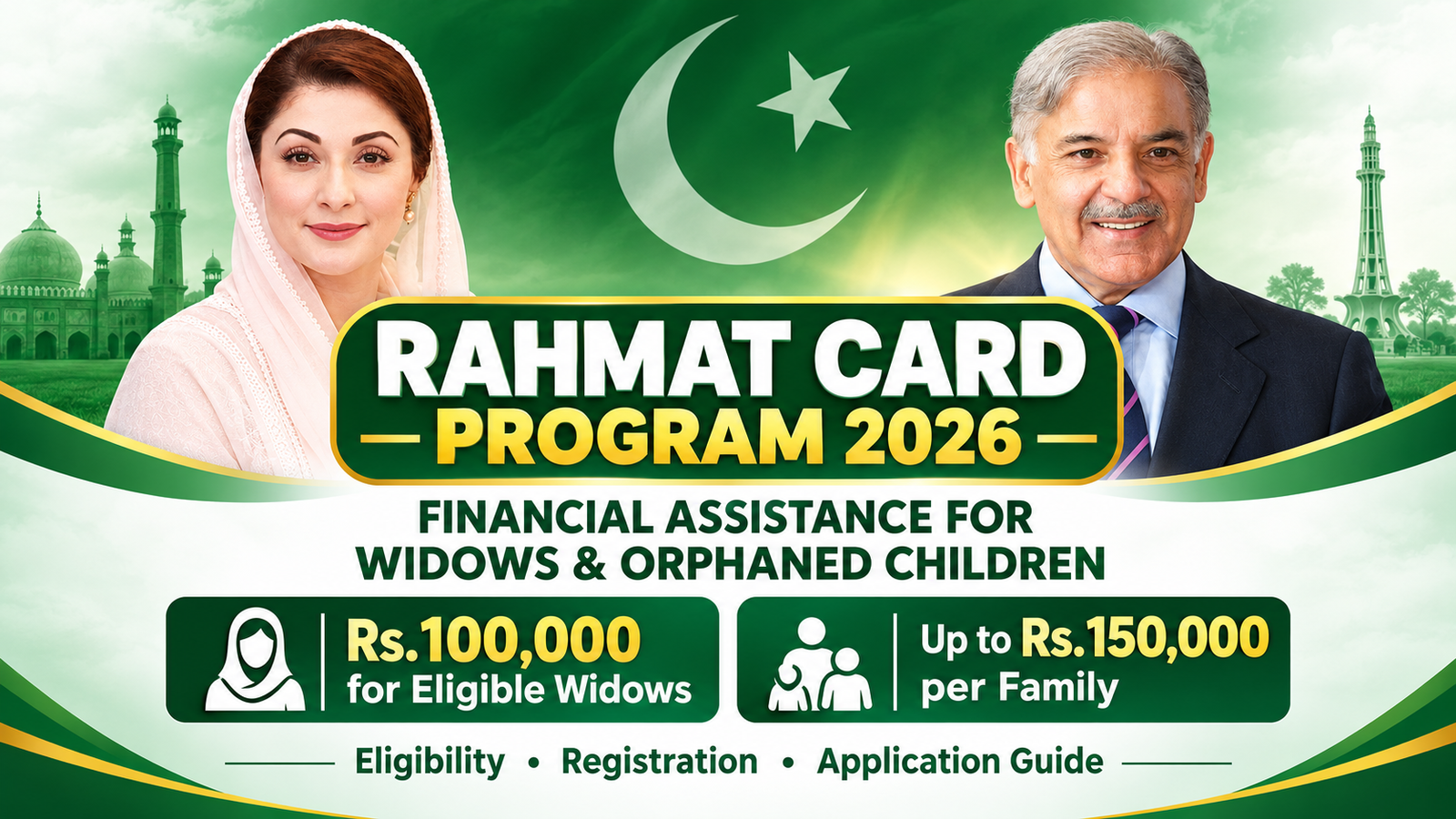
As per the information given the first stage has a budget of Rs. 5 Billion. Wants to help 50,000 families in Punjab. Widows who qualify can get Rs. 100,000 And each child who is an orphan can get Rs. 25,000. The total help for a family can’t go over Rs. 150,000.
The Rahmat Card also wants to make sure that the people getting help are chosen in a way. It wants to use registration and safe money transfers. The Punjab Socio-Economic Registry (PSER) NADRA checks and biometric checks are steps in the process.
This guide talks about the money help the rules to qualify, how to sign up what documents to bring, how to check if you’re eligible and what people should do before they apply. People should check the website for the latest rules and instructions before they share their personal information.
Table of Contents
- Overview of the Rahmat Card Program
- Key Highlights and Financial Assistance
- Who Is Eligible for the Rahmat Card?
- How to Apply for the Rahmat Card
- Documents and Information Applicants May Need
- How the Verification Process Works
- Payment. Financial Assistance
- Common Application Mistakes
Overview of the Rahmat Card Program
The Rahmat Card Program is a special help program for widows and children who lost their parents in Punjab. The main goal is to give money to families that are struggling to pay for food, school, health care and other basic needs after a family member dies.
For families when a husband or father passes away there is a sudden drop in the money they have. A parent or guardian left behind may need to handle all the expenses, school costs and medical bills with little money. Help from the government can make some of this easier.
Unlike help from charity a government program has rules, checks and ways to send money. These systems help find the people and make sure that the money from the government is used properly.
What is the main purpose of the Rahmat Card?
The main goals of the program are:
- To give money to widows and orphaned children who qualify.
- To help families with money problems.
- To make sure children can get what they need like school and health care.
- To make it easier for people to get government help through registration.
- To find the people by checking their economic situation and identity.
- To send the money in a way.
The program is about giving money not about guaranteeing an income. The money can help with some of the needs but people should not think it will cover everything or that they will get the same help again in the future.
Why is the program important?
Money problems can affect parts of a familys life. A woman who lost her husband may need to spend money on food and rent but on her childrens school. An orphan may need help with school supplies, clothes, food and health care.
A special grant can give some help in dealing with these needs. The family can decide what they need most and use the help according to the rules of the program.
The success of this program will depend on making sure that the people getting help are chosen fairly that signing up is easy that the checks are correct and that the money is given on time. It is also important that families know the rules and can tell the instructions from false ones.
Key Highlights of the Rahmat Card Program 2026
The following table shows the details of the program. People applying should go to the website for the latest news and any changes, to the rules.
| Program detail | Reported information |
| Program name | Rahmat Card Program |
| Government | Government of Punjab |
| Target beneficiaries | Eligible widows and orphaned children |
| Assistance for widows | Rs. 100,000 |
| Additional assistance | Rs. 25,000 per eligible orphan child |
| Maximum assistance | Rs. 150,000 per family |
| Initial budget allocation | Rs. 5 billion |
| First-phase target | 50,000 families |
| Socioeconomic verification | Punjab Socio-Economic Registry (PSER) |
| Identity verification | NADRA database, as applicable |
| Reported payment channels | Bank of Punjab and JazzCash |
| Reported helpline | 1077 |
| Official information portal | https://www.rahmatcard.punjab.gov.pk/ |
These numbers give the program details given in this guide. They should not be seen as a promise that every person who applies will get it that registration is taking place now or that a payment has been approved.
Knowing about the help
The help offered has a basic grant for widows and more help depending on the number of children who are orphans in the house.
For instance if a family gets the grant of Rs. 100,000 And another Rs. 25,000 For one child who is an orphan the total is Rs. 125,000. If the family gets help for two children who’re orphans the total could reach the highest amount of Rs. 150,000.
However people applying should check the rules, including how the program says a child is eligible how family relationships are shown and if there are other conditions.
Is the Rahmat Card a payment?
The information about the program says about the grants. Does not say if payments are done every month. So people should not think that Rs. 100,000 Or Rs. 150,000 Is paid each month.
The official website or the place that handles welfare should be checked for information about how paymentsre made, when they happen and any rules that come with the help.
Who Can Get the Rahmat Card Program?
Eligibility is an important part of applying for the Rahmat Card. People should look at the rules carefully before signing up because meeting one rule does not mean they will be approved.
The details given list widows who’re eligible for Zakat and children who are orphans in Punjab as the main people who can get help. It also says that checking money and identity is part of the process of choosing who gets it.
The following things can help people get ready. The final decision is based on the government rules.
Widows living in Punjab
Widows are the main people who get the Rs. 100,000 Grant. People should be ready to show who they are, where they live, their relationship status and other details from the application.
The exact rules of the program might say which papers or records are accepted as proof. People should follow those rules of guessing what will be accepted.
Families with children who’re orphans
The help includes Rs. 25,000 For each child who is an orphan up to a maximum of Rs. 150,000 For each family.
Families who want this extra help might need to give details about the children how they are connected to the person applying and if the children are eligible under the program rules.
People who are taking care of orphans should check if they can apply directly or if they need to follow another process. The given information does not cover all the rules about taking care of children or applying for them.
Living in Punjab
The program is from the Government of Punjab. Is for families in the province. People should check if they need an address in Punjab, a certificate of domicile a record of living there or another way to prove they live in the province.
A national identity card on its own should not be thought of as proving everything about being eligible. The official instructions will say what proof of being in Punjab is accepted.
Financial eligibility
The program information says that the Punjab Socio-Economic Registry is part of choosing who gets help. Money details can help the people in charge check the situation of each family and decide if they meet the rules of the program.
People should give details about their family, their money how many people are in the house and other things that are asked. They should also fix records through the right places when needed.
Checking identity
NADRA records are another way to check identity. People might need identity papers and correct personal details so the right people can match their application with official records.
If a name, birth date, relationship status or family link is different between papers and government records the application might need checking.
Who should check the rules before applying?
The following people should pay attention to the rules about being eligible:
- Widows who want money support and meet the conditions of the program.
- Families taking care of children who’re orphans.
- People whose PSER information might be missing or out of date.
- People whose identity or family details need fixing.
- Guardians who need to know how to apply for children.
Being in one of these groups does not automatically mean someone is eligible. Only the right people can say if a person or family is allowed.
How to Apply for the Rahmat Card Program 2026
People should use the website of the government or a place that handles welfare to check the way to apply. The information given says that there is a website, a mobile app and local Zakat and Ushr offices as possible places to get help.
Because the way to apply can change, check if people can apply now before sending papers or going to an office.
Step 1: Go to the Rahmat Card website
Open the website that is said to be the real one:
https://www.rahmatcard.punjab.gov.pk/
Look at the news and instructions. Find details about when to apply what’s needed to be eligible the forms to fill and any papers that must be given.
Be careful when searching on the internet. Sites, social media pages and ads that are not official might use names but are not from the government.
Step 2: Look at the rules about being eligible
Before starting to apply read the rules about being eligible. Check if the family meets the rules for living in the province being a widow being an orphan and being eligible for money help.
If unsure if a child is allowed for help ask an official office before sending the application.
Step 3: Put personal details
Fill the application with the details that are asked for on the official form. Depending on the rules this can include:
- Name of the person applying.
- CNIC number or other identity details that are accepted.
- Phone number.
- Address where they live.
- Details about the family and home.
- Information about children who’re orphans if needed.
- PSER or money details if needed.
Check each part before sending it. Wrong numbers, wrong names and old phone numbers can make it harder to check.
Step 4: Send the application through the way
Follow the instructions on the website to send the form. If there is an app that is allowed check where it comes from before downloading it.
People who can’t do the application online should ask a Zakat and Ushr office if help is available and what they should do.
Don’t send than one application just to have more chances. Follow the rules about sending the application again and how to register for a family.
Step 5: Keep the application number
If the system gives a registration number, a confirmation or a tracking number save that safe. It might help to check on the application or explain the situation to a person.
An application that is sent is not the same as one that is accepted. People should wait for approval and answer any real requests, for more information.
Papers and Information People May Need
Getting the papers before applying can make the process easier. However the list below is a guide, not a list of papers that are definitely needed for the Rahmat Card Program.
| Information or document | Why it may be needed |
| Valid CNIC or accepted identity document | To verify the applicant’s identity |
| Contact number | To receive relevant communications |
| Punjab residential details | To establish provincial eligibility |
| Husband’s death certificate, if required | To verify widowhood |
| Children’s identity or birth records, if required | To establish children’s identities and relationships |
| Family information | To verify household composition |
| PSER information | To support socioeconomic assessment |
What happens if a document is missing?
Do not think the application will be automatically turned down just because you lack a document. First look at the rules and ask the office if another record or a correction process will be accepted. For instance if a family record has a spelling the applicant should get an official correction instead of sending mixed data. Do not change documents or give false details to satisfy the rules. Wrong information can hold up the process. Could change whether you qualify.
How Does the Verification Process Work?
The program uses checks to make sure the choice of beneficiaries is clear. PSER and NADRA are data sources and biometric checks are tied to the payment step.
In life applicants should know that each stage has its own purpose.
Socioeconomic assessment through PSER
The Punjab Socio-Economic Registry holds household data that the government uses for welfare plans. The program says PSER will help find families that qualify. Applicants must keep their household data correct and follow rules if they need to update it.
Identity checks through NADRA
Identity verification lets authorities make sure an applicant’s details match the records. Differences in names ID numbers or family links might need to be clarified.
Biometric authentication for payment
Biometric checks can prove a recipient’s identity when they collect approved money through a supported payment channel. The exact steps, places and other options for people who cannot do checks should be confirmed with the payment provider.
Important: Verification alone does not mean you will get money. Approval depends on the rules the review and whether the program has funds available.
Payment Methods and Financial Assistance
The program lists the Bank of Punjab and JazzCash as the ways to send money. The exact way you can collect money should be confirmed by instructions.
Applicants should not open an account pay a fee or give away private data just because an unofficial person says it is needed for the Rahmat Card grant.
After receiving an approval notification check the following:
- The approved amount of help.
- The official way to collect payment.
- Any needed identity or biometric check.
- The chosen place to collect money if it matters.
- Steps to fix an slow transaction.
If the money you get is different from what you thought ask the authority to explain how they counted it. The stated top of Rs. 150,000 Per family is a limit, not a promise that every household will get that much.
Common Application Mistakes to Avoid
Applicants can avoid problems by preparing well and following the official rules.
Submitting details: Check names, CNIC data, phone numbers and household records before sending the form.
Ignoring eligibility rules: Read the criteria instead of thinking all widows or families with orphaned children will automatically qualify.
Trusting registration agents: Use the government portal or approved offices. Be careful of anyone who asks for money to promise approval.
Sharing data: Do not give passwords one‑time codes or bank PINs to strangers. Give identity data through checked official steps.
Assuming registration means approval: Keep your reference number. Wait for an official decision.
Relying on announcements: Check the latest registration dates, application steps and payment plans before acting on info from social media.
Not fixing record mistakes: If ID or household data is wrong ask the authority how to correct it instead of sending conflicting details.
How to Check Rahmat Card Application Status
After sending an application applicants might want to know if their registration was received, if their data is being checked or if a decision has been made.
The status‑checking ways depend on the system. Applicants should use the Rahmat Card portal. Call an authorized government office for up‑to‑date instructions, not unverified third‑party sites.
Step‑by‑step status‑checking guide
- Visit the portal: Open https://www.rahmatcard.punjab.gov.pk/ and find an application‑status or tracking option.
- Find your registration details: Keep your application reference number and any acknowledgment you got when you registered.
- Enter the requested info: Give the details the verified official system asks for.
- Look at the shown status: Follow any instructions, about checks, missing data or next steps.
- Contact the office if necessary: If the system does not give a clear answer ask an authorized representative, for help.
These steps are a guide. I suggest checking the menu names and tracking procedure on the live portal.
What do different application statuses mean?
The following table explains status terms that welfare application systems may use. It does not confirm that the Rahmat Card portal uses these labels.
| Possible status | General meaning | Recommended action |
| Submitted | The application has been received | Keep the reference number |
| Under verification | Applicant details are being checked | Wait for official instructions |
| Additional information required | More details or clarification may be needed | Follow the official request |
| Approved | The application has passed the relevant approval process | Check payment instructions |
| Not eligible | The application does not meet the applicable criteria | Ask about the reason and any review procedure |
| Payment pending | Payment has not yet been completed | Check the official payment schedule |
| Payment completed | The system records a completed disbursement | Follow official instructions if funds are not received |
Applicants should not think that a delayed status means their application has been automatically rejected. Processing times can vary depending on verification needs, administrative steps and how the program is currently operating.
Rahmat Card Helpline 1077: How to Seek Assistance
The program information provided lists 1077 as a helpline linked to the Rahmat Card initiative. Since contact details and services can change it is important to confirm that this number is still active for the Rahmat Card program through the government website before using it.
If the helpline is confirmed to be working it can be a first step for questions about registration, eligibility, verification and payment processes.
What information should you prepare before calling?
Have the following details ready, if applicable:
- Your application reference number.
- Your registered phone number.
- The kind of problem you are facing.
- The date you submitted your application.
- Any message or error notification you received.
Explain your issue clearly. Write down any instructions given by the representative. If they direct you to another department ask for the office or the proper contact method.
Never give your banking PIN, password or one-time verification code to anyone claiming to be a helpline staff member. If you get a call or message demanding money to approve your application check the claim independently through a source.
Benefits of the Rahmat Card Program
The program is designed to provide potential benefits for eligible households. The actual benefits will depend on how well the program is implemented, the final eligibility rules and how assistance is delivered.
Financial relief for widows
The Rs. 100,000 Grant could help a widow cover immediate household needs. Depending on her situation the money could go toward food, rent, electricity, clothing, healthcare or other essentials.
This support can be important when a family loses income suddenly. The grant should be seen as temporary help, not a long-term income solution.
Additional assistance for orphaned children
The program reports Rs. 25,000 Per eligible orphan child up to a family limit. This recognizes that families with children often face costs.
Depending on the household’s needs and program rules the support might help with school supplies, uniforms, transport, nutrition or medical care.
Accessible welfare registration
Online registration can reduce the need for some applicants to make repeated trips to government offices. A run digital system may also make it easier to submit information and check application status.
However online registration does not guarantee success for everyone. People with internet access, low digital skills or trouble using identity verification services may still need help from authorized offices.
Structured beneficiary selection
The program uses PSER and NADRA data to help identify and verify applicants. Digital records can reduce mistakes if the data is accurate and the procedures work correctly.
No system is perfect. Errors can still happen. That is why clear complaint paths and easy correction methods are needed for applicants with missing or wrong details.
Practical Tips for Applicants
Taking an approach can help applicants avoid unnecessary trips, confusion and fraud.
Verify the website before entering information
Use the official Rahmat Card website address. Double-check the spelling of the domain. Avoid websites that look like government sites but are not real. Do not share information with sites that ask for details.`
Keep household records consistent
Check your identity documents and family records before applying. If there is a problem ask the authority how to fix it.
Save communications
Keep application confirmation messages, reference numbers and any genuine updates about your application. These can help when following up with government offices.
Avoid fees
Do not pay anyone claiming to guarantee approval speed up selection or increase your grant. If a fee is officially required, verify it directly with the government.
Ask for clarification when the rules are unclear
If you’re not sure whether a child qualifies, if a guardian can apply or which documents are accepted get clarification before submitting.
Protect your personal information
Documents like CNIC, family records and application details are sensitive. Share them through verified official channels. Do not post photos of your CNIC, application records or payment details on media.
What Should Applicants Do If Their Application Is Delayed or Rejected?
A delay or rejection can be stressful especially if a family needs help. Applicants should first figure out if the problem comes from missing information, identity verification, eligibility or the current processing speed.
If your application is delayed
- Check the website for any status updates.
- Review your application reference and earlier messages.
- Confirm if more information has been requested.
- Contact the office if the delay continues and a follow-up option exists.
Do not submit an application right away. First check whether your original application is still active and whether duplicate registration is allowed.
If your application is rejected
Ask the authority if they can explain the reason for rejection. If the decision was based on wrong records ask how to correct or review the case.
Applicants should not assume an appeal is possible unless the government has made it available. Follow the rules submit honest supporting documents and keep copies of all official messages.
If you cannot complete biometric verification
Contact the payment provider or welfare office to ask what steps to take. Do not trust anyone who promises to skip steps or collect payments on your behalf without proper approval.
Rahmat Card Compared With Forms of Welfare Assistance
The Rahmat Card is meant as a targeted grant for eligible widows and orphaned children. Other government welfare programs may support groups or offer different types of help.
Understanding these differences can help families find the assistance. It also helps avoid the mistake of thinking that eligibility, for one program automatically means you qualify for another.
| Feature | Rahmat Card Program | Other welfare programs |
| Intended beneficiaries | Eligible widows and orphaned children, according to the supplied details | May target low-income households, older people, persons with disabilities, or other groups |
| Assistance type | Reported cash grant | May include cash assistance, food support, education assistance, or other benefits |
| Eligibility assessment | Reportedly includes PSER and identity verification | Depends on the individual program |
| Payment method | Reportedly includes Bank of Punjab and JazzCash channels | Varies by program |
| Application procedure | Follow the Rahmat Card’s official instructions | Follow each program’s official requirements |
This is a general comparison, not a confirmation of current eligibility or payment arrangements for any other scheme. Before applying for multiple programs, check their respective rules, including any restrictions on receiving overlapping assistance.
Conclusion
The Rahmat Card Program 2026 is a government initiative in Punjab designed to provide support to eligible widows and orphaned children. The program offers a grant of Rs. 100,000 To each widow. For families with children an additional Rs. 25,000 Is given per child up to a maximum of Rs. 150,000 Per family.
For anyone wanting to apply the important steps are to carefully review the official eligibility rules gather correct identity and household documents and use only authorized registration methods. Verification through PSER and NADRA is part of the process to ensure transparency. Payments will be made securely through the Bank of Punjab and JazzCash.
Applicants should keep in mind that the amounts announced and the first-phase targets do not mean everyone will be approved. Availability of registration required documents, payment timelines and other conditions must be checked directly on the Rahmat Card website.
Following these steps helps families make choices stay safe from fraud and protect their personal information while applying for real government help.
Summary
The Rahmat Card Program 2026 is a welfare program launched by the Government of Punjab for widows and orphaned children. It provides Rs. 100,000 To widows and Rs. 25,000 For each orphan child, with a family cap of Rs. 150,000. The first phase aims to assist 50,000 families with a budget of Rs. 5 Billion. Eligibility is verified using PSER and NADRA systems. Payments will be processed via the Bank of Punjab and JazzCash. Applicants must visit the Rahmat Card website to confirm current registration details, eligibility and payment updates before sharing any personal data.