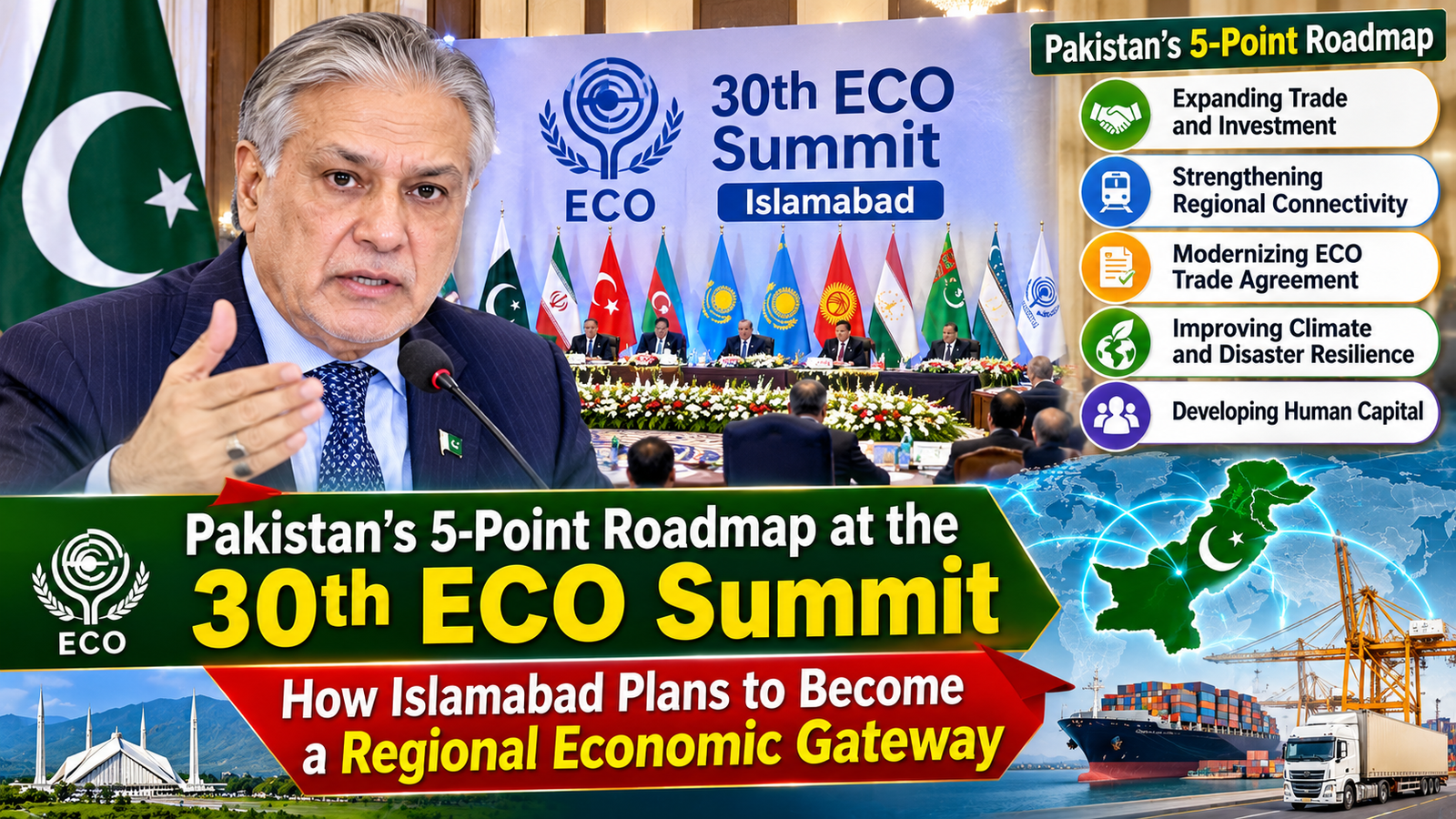
Pakistan’s 5-Point Roadmap at the 30th ECO Summit
When leaders and ministers from across the Economic Cooperation Organization (ECO) gathered in Islamabad for the 30th summit, Pakistan used the platform to present something larger than a routine diplomatic statement. Deputy Prime Minister and Foreign Minister Ishaq Dar outlined a five-point roadmap built around trade, investment, regional connectivity, climate resilience and human development. The stated aim is to position Pakistan as an economic gateway linking South Asia, Central Asia and global markets.
For readers following regional affairs, business owners watching trade corridors, or students of international economics, the key question is simple: what does this roadmap actually propose, and what would it take to work? Announcements at summits are easy to make and hard to deliver. The real test lies in customs procedures, border operations, financing, political stability and the willingness of ten member states to coordinate.
This article explains the five priorities in plain language, looks at Pakistan’s role as a transit route for landlocked Central Asian economies, and examines the security context that Dar placed at the center of his message. It also covers the ECO Vision 2035 framework, the modernization of the ECO Trade Agreement, and the practical hurdles ahead. Where the information is still developing, the article says so rather than guessing.
Table of Contents
- What Is the ECO and Why Does the 30th Summit Matter?
- Overview: Pakistan’s 5-Point Roadmap
- Key Highlights at a Glance
- Priority 1: Expanding Trade and Investment
- Priority 2: Strengthening Regional Connectivity
- How Pakistan’s Ports Could Serve Central Asia
- Why Customs and Transit Rules Matter as Much as Roads
What Is the ECO and Why Does the 30th Summit Matter?
The Economic Cooperation Organization is a regional intergovernmental body focused on economic, technical and cultural cooperation. It has ten member states: Pakistan, Afghanistan, Iran, Türkiye, Azerbaijan, Kazakhstan, Kyrgyzstan, Tajikistan, Turkmenistan and Uzbekistan.
Together, these countries span a vast geographic belt that connects Europe, the Middle East, Central Asia and South Asia. The bloc includes energy-rich economies, large agricultural producers, major trading nations and several landlocked states that depend on neighbors for sea access. That mix is exactly why the organization has long been described as having considerable untapped potential.
Why This Summit Stands Out
Several factors give the Islamabad summit added weight:
- Pakistan is hosting, which allows it to shape the agenda and showcase its own economic vision.
- ECO Vision 2035 is under examination, a decade-long framework for deeper integration, stronger transport networks and sustainable development.
- The draft Islamabad Declaration was finalized by senior officials ahead of the ministerial meeting, signaling an intention to produce a formal outcome.
- Regional tensions are high, and security concerns are directly shaping the economic conversation.
Preparations were finalized at a November 15 meeting chaired by Foreign Secretary Ambassador Asim Iftikhar Ahmad. Senior officials reviewed ECO programs, institutional performance, and administrative and financial matters, and also finalized the draft declaration and ministerial agenda.
One notable detail: Afghanistan, despite being one of the ten member states, was absent from the high-level summit. That absence became part of the diplomatic message, which we return to in Stage 2.
Overview: What Is Pakistan’s 5-Point Roadmap?
Pakistan’s roadmap is designed to turn regional cooperation into what Dar described as measurable economic progress. The five priorities are:
- Expanding trade and investment
- Strengthening regional connectivity
- Modernizing the ECO Trade Agreement
- Improving climate and disaster resilience
- Developing human capital through education, innovation and vocational training
Dar also drew attention to the region’s strengths: large energy reserves, agricultural potential, natural resources and a strategic geographic position. His argument was that these advantages remain underused, and that coordinated policies could convert them into lasting prosperity.
The Core Idea in One Sentence
Pakistan wants to act as a bridge, using its geography and Arabian Sea ports to connect Central Asian economies with South Asia and global markets, while pushing the ECO to adopt more modern trade rules and shared approaches to climate and skills.
This is a policy vision, not a completed project. Whether it translates into results depends on decisions by all member states, not Pakistan alone.
Key Highlights at a Glance
| Area | What Pakistan Proposed |
|---|---|
| Trade and investment | Strengthen regional supply chains, improve market access, encourage private-sector participation, especially small and medium-sized businesses |
| Connectivity | Link landlocked Central Asia to global markets through Karachi, Port Qasim and Gwadar |
| Trade agreement | Modernize the ECO Trade Agreement into a more inclusive, digitally enabled framework |
| Climate resilience | Cooperate on early-warning systems, sustainable water management, disaster preparedness and climate-resilient infrastructure |
| Human development | Invest in education, research, technological innovation, entrepreneurship and professional training |
| Regional security | Engage Afghanistan on neighbors’ legitimate security concerns; support de-escalation and diplomacy in wider conflicts |
Priority 1: Expanding Trade and Investment
What Pakistan Is Asking For
The first pillar focuses on making it easier and more attractive for businesses across the ECO region to trade with one another and invest across borders. Pakistan pledged to strengthen regional supply chains, improve market access and encourage private-sector participation.
The emphasis on small and medium-sized enterprises (SMEs) is worth noting. Large corporations can usually manage complex customs systems and cross-border logistics. SMEs often cannot. If regional trade rules remain complicated or unpredictable, smaller firms are typically the first to be shut out.
Why Regional Supply Chains Matter
A regional supply chain is a network in which producers, processors, transporters and sellers in neighboring countries depend on one another. When it works well, it reduces costs, shortens delivery times and makes economies less reliant on distant markets.
For the ECO region, examples of where such cooperation could apply include:
- Agriculture: Central Asian and South Asian producers have different growing seasons and strengths, creating natural trade complementarity.
- Energy: Energy-rich members could supply energy-short neighbors if transport and pricing arrangements are workable.
- Manufacturing inputs: Raw materials and intermediate goods could move between member states more smoothly under simplified rules.
These are illustrative possibilities consistent with the region’s stated strengths, not confirmed project announcements.
A Realistic View
Expanding trade is not only about signing agreements. Businesses need:
- Predictable rules that do not change without notice
- Reasonable costs at borders
- Reliable payment and financing channels
- Confidence that security conditions will not disrupt shipments
This is why the roadmap links economic goals to security and infrastructure rather than treating them separately.
Priority 2: Strengthening Regional Connectivity
What Connectivity Means in Practice
Connectivity is a broad term. It includes roads, railways, ports and border crossings, but also digital systems, customs data sharing and transit agreements. Pakistan’s roadmap treats connectivity as the practical foundation for everything else, since trade cannot grow if goods cannot move efficiently.
Dar described the region’s strategic geography as a core asset. Pakistan sits at a junction where Central Asia, South Asia and the Arabian Sea meet, which is the basis of its claim to be a natural gateway.
Connecting the Landlocked
Several ECO members, including Kazakhstan, Kyrgyzstan, Tajikistan, Turkmenistan and Uzbekistan, are landlocked Central Asian economies. Landlocked countries generally face higher transport costs and greater dependence on neighboring states for access to international shipping routes. A reliable path to a warm-water port can therefore be economically significant for them.
How Pakistan’s Ports Could Serve Central Asia
A key focus of Islamabad’s strategy is connecting landlocked Central Asian economies with international markets through Pakistan’s Arabian Sea ports. Dar identified three strategically important gateways:
Karachi
Karachi is Pakistan’s largest port city and a long-established commercial hub. Its existing trade infrastructure makes it the most familiar entry point for cargo.
Port Qasim
Located near Karachi, Port Qasim is another major port that handles significant cargo volumes and complements Karachi’s capacity.
Gwadar
Gwadar, on the Balochistan coast, has been promoted as a deep-sea port with long-term potential as a transit and trade gateway.
Dar said these ports could link Central Asia with South Asia and global trading networks. Details such as cargo volumes, new route agreements or investment amounts were not part of the information available for this article, so readers should watch for official follow-up announcements rather than assume specific figures.
The Caution Dar Himself Raised
Importantly, Dar cautioned that physical infrastructure alone would not guarantee success. This is an honest acknowledgment of a common problem: countries can build ports and highways yet still see little traffic if rules, costs and delays make the route unattractive compared with alternatives.
Why Customs and Transit Rules Matter as Much as Roads
Dar stressed that three softer elements would be necessary to make regional commerce commercially viable:
- Simplified customs procedures: fewer forms, clearer rules and faster clearance
- Efficient border operations: shorter waiting times and better coordination between agencies
- Predictable transit arrangements: traders knowing in advance how long a journey will take and what it will cost
A Simple Example
Imagine a trader in Central Asia choosing between two routes to the sea. Route A is shorter on the map but involves unclear paperwork, long border queues and uncertain fees. Route B is longer but fast, transparent and predictable. Most businesses will choose Route B, because time and certainty often matter more than distance.
This hypothetical illustrates why Pakistan’s emphasis on procedures is sensible. Roads and ports create the possibility of trade, while good administration turns that possibility into actual shipments.
Digital Tools and Modernization
Pakistan also backed modernizing the ECO Trade Agreement through a more inclusive and digitally enabled framework. This builds on a negotiating roadmap approved by ECO trade ministers in November 2025. Digital systems, such as electronic documentation and data sharing between customs authorities, are widely seen as ways to reduce delays, though the specific tools the ECO will adopt have not been detailed in the source material.
Priority 3: Modernizing the ECO Trade Agreement
What Is Being Proposed?
The third pillar targets the rulebook itself. Pakistan backed modernizing the ECO Trade Agreement through a framework that is more inclusive and digitally enabled. This builds on the negotiating roadmap approved by ECO trade ministers in November 2025.
Trade agreements shape what businesses can actually do. They set rules on tariffs, documentation, standards and dispute handling. An outdated agreement can leave traders working with paperwork and procedures that no longer match how modern commerce operates.
What “Inclusive” and “Digitally Enabled” Could Mean
The source material does not spell out the technical details, so it is better to describe the likely direction than to invent specifics.
- Inclusive generally means rules that work for smaller economies and smaller businesses, not only for the largest players.
- Digitally enabled typically points to electronic documentation, online customs processing and data exchange between agencies.
Any final design will depend on negotiations among all member states, and the details may change before anything is adopted.
Why This Matters for Businesses
For a small exporter, a modern trade framework could mean less time spent on forms and more predictability about costs. For governments, it could mean better visibility of cross-border trade flows. Whether those benefits materialize depends on implementation, which has historically been the harder part of regional cooperation.
Priority 4: Improving Climate and Disaster Resilience
Why Climate Appears in a Trade Roadmap
At first glance, climate and trade may seem unrelated. In practice, they are closely linked. Floods, droughts and extreme weather can damage roads, ports, farmland and power systems, which are the very assets a trade corridor depends on.
Dar called for collective action against escalating climate threats, water scarcity and natural disasters. He urged ECO countries to cooperate in four areas:
- Early-warning systems that give communities and authorities time to prepare
- Sustainable water management across a region where water is a shared and sometimes scarce resource
- Disaster preparedness through coordinated planning and response
- Climate-resilient infrastructure built to withstand extreme conditions
The Logic of Shared Risk
Many climate and water challenges do not stop at national borders. A river, a weather system or a drought can affect several countries at once. Sharing data, forecasting tools and response experience is often more efficient than each country building everything alone.
The source material does not mention specific funding, projects or timelines for this pillar. Readers should therefore treat it as a statement of intent and watch the final Islamabad Declaration and later announcements for concrete commitments.
Priority 5: Developing Human Capital
Education, Innovation and Skills
The fifth priority looks beyond infrastructure to people. Dar identified education, research, technological innovation, entrepreneurship and professional training as essential investments for preparing the region’s youth for emerging economic opportunities.
The reasoning is straightforward. A port or a rail link creates opportunity, but people with the right skills are needed to run logistics systems, manage digital customs platforms, start businesses and work in new industries.
Where Cooperation Could Help
Possible areas for regional collaboration include:
- Vocational training aligned with the needs of trade, logistics and manufacturing
- Research partnerships between universities and institutes in member states
- Entrepreneurship support, especially for young founders and small firms
- Technology skills that support digital trade and modern customs systems
These are logical applications of the priority Dar described. Specific programs or exchange schemes were not detailed in the source material.
The Security Context: Why Dar Put It at the Center
Afghanistan and Neighbors’ Security Concerns
One of the most significant parts of Dar’s message concerned regional security. He stressed that Afghanistan must address its neighbors’ legitimate security concerns to unlock meaningful cooperation.
The message carried added weight because Afghanistan remained absent from the high-level summit, even though it is one of the ECO’s ten member states. Pakistan’s position links economic cooperation to security, essentially saying that deeper integration is hard to achieve without addressing security worries.
This is Pakistan’s stated position as presented at the summit. Other member states or Afghanistan itself may see the issue differently, and readers looking for a full picture should consult additional sources.
Wider Conflicts and Economic Risk
Dar also warned that armed conflicts can disrupt energy supplies, investment, transport networks and development projects far beyond the countries directly involved. Addressing the US-Iran conflict, he reaffirmed Pakistan’s commitment to negotiations and de-escalation.
He said Prime Minister Shehbaz Sharif and Chief of Defence Forces and Chief of Army Staff Field Marshal Asim Munir remained engaged with friendly countries and international partners to encourage peaceful solutions. Pakistan, he added, would continue supporting diplomacy in accordance with international law and the United Nations Charter.
Why Security and Trade Are Connected
Investors and shippers weigh risk carefully. Even a well-built corridor can lose appeal if travel conditions are uncertain or insurance costs rise. For that reason, the security discussion is part of the economic argument, not a separate topic.
ECO Vision 2035: The Bigger Framework
The summit is also examining ECO Vision 2035, a decade-long framework for deeper economic integration, stronger transport networks and sustainable regional development.
Think of the five-point roadmap as Pakistan’s proposed priorities and ECO Vision 2035 as the shared, longer-term framework within which such priorities could be pursued.
| Element | Pakistan’s 5-Point Roadmap | ECO Vision 2035 |
|---|---|---|
| Scope | Pakistan’s proposed priorities | Organization-wide framework |
| Time horizon | Not specified in the source material | Decade-long |
| Focus | Trade, connectivity, trade agreement, climate, human capital | Integration, transport networks, sustainable development |
| Decision-making | Presented by Pakistan | Examined by member states |
Final decisions will rest with all ten members, so the outcome of the Islamabad discussions is worth watching.
Challenges Ahead: A Realistic Assessment
Common Mistakes When Reading Summit Announcements
- Treating a roadmap as a finished project. A roadmap sets direction. It does not guarantee delivery.
- Assuming infrastructure equals trade. Dar himself cautioned that physical infrastructure alone is not enough.
- Ignoring politics. Economic plans in this region are closely tied to security and diplomacy.
- Expecting quick results. Trade agreement reform and regional integration typically take years.
Practical Obstacles
- Coordinating ten member states with different economies and priorities
- Aligning customs and border systems across countries
- Securing financing for infrastructure and digital systems
- Managing security risks that could affect corridors and investment
Pros and Cons of Pakistan’s Roadmap
Potential Strengths
- It addresses practical issues such as customs, border operations and transit predictability, not only headline infrastructure.
- It includes SMEs and the private sector.
- It links trade with climate resilience and skills, which supports longer-term sustainability.
- It builds on existing ECO processes, including the November 2025 trade ministers’ roadmap.
Potential Weaknesses and Uncertainties
- Specific funding, timelines and project details were not included in the available information.
- Success depends on cooperation from all members, and Afghanistan’s absence highlights the political complexity.
- Regional security tensions could slow progress.
Who Should Follow This Story Closely?
- Traders and logistics firms interested in Central Asia-South Asia routes
- SME owners who may benefit from simpler trade rules in the future
- Students and researchers of regional economics and diplomacy
- Investors monitoring infrastructure, ports and trade corridors
Anyone planning business decisions should rely on official notifications and professional advice rather than a summit announcement alone.
Frequently Asked Questions
What is the 5-point roadmap Pakistan presented at the ECO summit?
It covers expanding trade and investment, strengthening regional connectivity, modernizing the ECO Trade Agreement, improving climate and disaster resilience, and developing human capital through education, innovation and vocational training.
Which Pakistani ports are part of the plan?
Dar identified Karachi, Port Qasim and Gwadar as strategically important gateways linking Central Asia with South Asia and global trading networks.
Which countries belong to the ECO?
The ten members are Pakistan, Afghanistan, Iran, Türkiye, Azerbaijan, Kazakhstan, Kyrgyzstan, Tajikistan, Turkmenistan and Uzbekistan.
Why was Afghanistan not at the summit?
Afghanistan remained absent from the high-level summit despite being a member. The source material does not give reasons, so this article does not speculate. Dar did say Afghanistan must address its neighbors’ legitimate security concerns for meaningful cooperation.
What is ECO Vision 2035?
It is a decade-long framework for deeper economic integration, stronger transport networks and sustainable regional development, and it is being examined at the summit.
Conclusion
Pakistan’s five-point roadmap offers a clear vision: connect landlocked Central Asian economies with global markets through Pakistani ports, modernize trade rules, prepare for climate risks and invest in young people’s skills. Its most credible feature may be Dar’s own admission that roads and ports are not enough. Simpler customs, efficient borders and predictable transit are what turn infrastructure into commerce.
The plan also faces real constraints. Specific funding and timelines were not part of the available information, security tensions remain, and success depends on ten members working together. The outcomes of the Islamabad Declaration and ECO Vision 2035 discussions will show how far the roadmap moves from ambition to action.
Summary
At the 30th ECO Summit in Islamabad, Pakistan presented a five-point roadmap covering trade and investment, regional connectivity, a modernized ECO Trade Agreement, climate resilience and human capital development. It aims to connect landlocked Central Asian economies with global markets through Karachi, Port Qasim and Gwadar, while stressing that customs, border and transit reforms matter as much as infrastructure. Deputy Prime Minister Ishaq Dar also linked cooperation to regional security and called for de-escalation in wider conflicts. ECO Vision 2035 is under examination. Funding and timelines remain unclear, so progress will depend on cooperation among all ten member states.