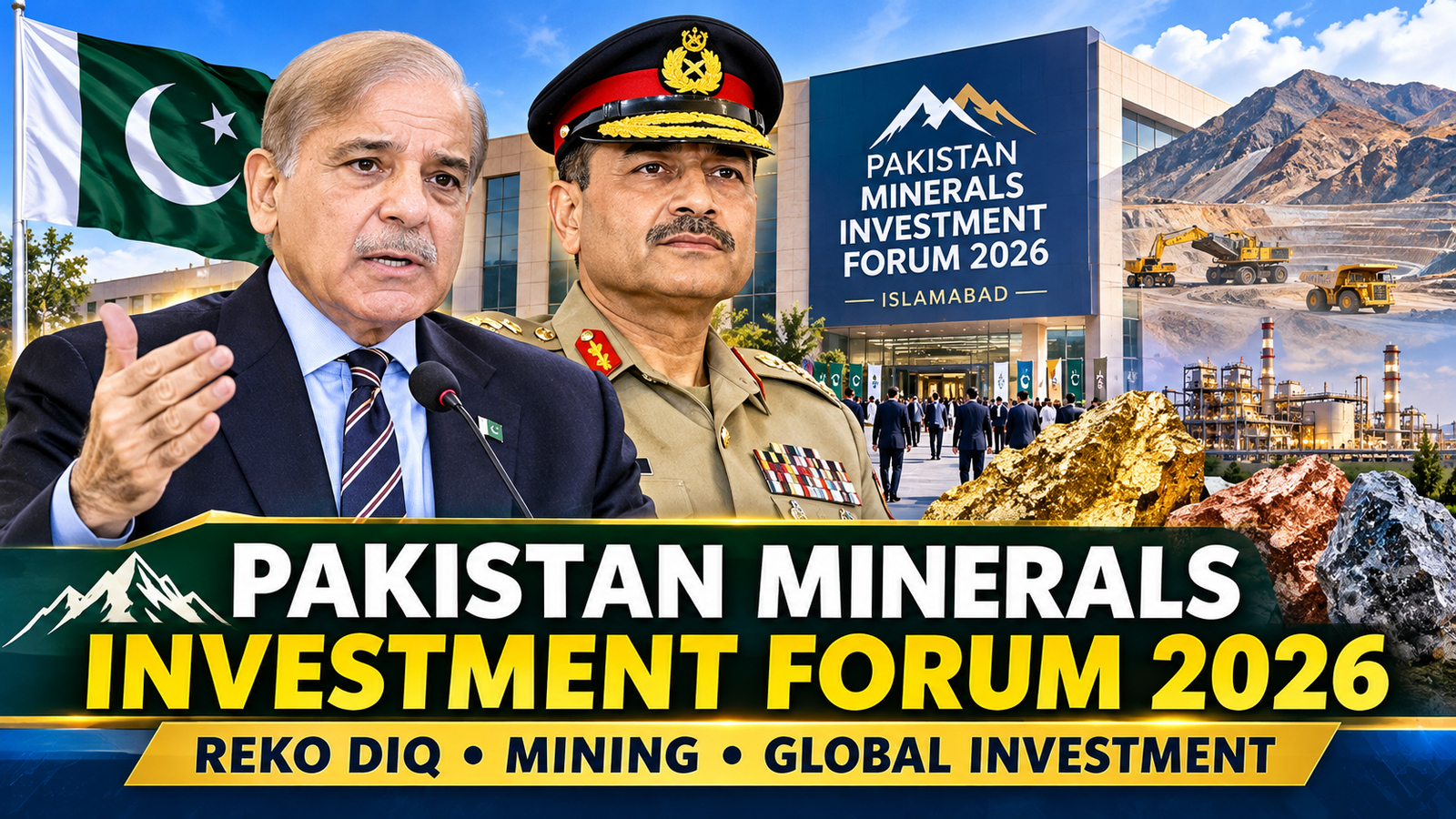
Pakistan Minerals Investment Forum 2026: What Pakistan’s Leaders Promised Global Investors
Introduction
Pakistan is trying to change how the world sees its mining sector. At the Pakistan Minerals Investment Forum 2026 in Islamabad, senior civil and military leaders presented the country as a long-term destination for mineral investment, not just a source of raw ore. Delegations, exhibitors and attendees came from across the world to hear the pitch.
If you are an investor, a student of the economy or a reader following Pakistan’s development agenda, the speeches raise practical questions. What exactly was promised? How does Pakistan plan to protect investments? What does “value addition” mean for a country that has long exported raw minerals and imported finished products? And what would it mean for local communities?
This article walks through the main messages from the forum, starting with the remarks of the Chief of Defence Forces and the Prime Minister. It separates official commitments from long-term ambitions, and it explains the key terms and projects mentioned, including the Reko Diq project and the Tethyan copper belt. The second part covers the petroleum minister’s address, infrastructure plans, practical takeaways and frequently asked questions.
Table of Contents
- Overview: What Was the Pakistan Minerals Investment Forum 2026?
- Key Highlights at a Glance
- Field Marshal Asim Munir’s Address
- Security for the mining ecosystem
- From raw exports to the full value chain
- Benefits for local communities
- Prime Minister Shehbaz Sharif’s Address
- The economic vision
- Reko Diq and the Tethyan copper belt
- Ending raw mineral exports
- Simplifying procedures and building trust
- Security, infrastructure and community cooperation
- Skills, youth and responsible mining
Overview: What Was the Pakistan Minerals Investment Forum 2026?
The Pakistan Minerals Investment Forum 2026 was a two-day event held in Islamabad to attract international investment into Pakistan’s mineral sector. It opened on Thursday, and the second day featured major addresses from the country’s top leadership. According to state-run Radio Pakistan, delegations, exhibitors and attendees from across the world took part.
The forum showcased a wide range of mineral resources, from coal and salt to gold and critical minerals. Organisers and speakers promised predictable, investor-friendly policies, institutional support and security. Prime Minister Shehbaz Sharif recalled that a similar forum took place last year and said he was renewing a commitment made then, which suggests the event is part of an ongoing effort rather than a one-off.
Why does this forum matter?
Investment decisions in mining take years and often involve very large sums. Investors therefore look for clear rules, reliable data, secure operations and supporting infrastructure before committing money. The forum was Pakistan’s attempt to address each of these concerns in one place, in front of an international audience.
Key Highlights at a Glance
Here are the main points reported from the forum, based on the statements of the officials who spoke:
- Competitive destination: Chief of Defence Forces (CDF) and Chief of Army Staff Field Marshal Asim Munir said Pakistan aims to become a competitive destination for long-term mineral investment.
- Security assurance: Field Marshal Munir said all possible measures were being taken to protect the entire mining ecosystem, including mines, miners, investments, industries and projects.
- Value-chain focus: Both Field Marshal Munir and the Prime Minister stressed moving beyond raw exports toward refining and manufacturing.
- Reko Diq timeline: The Prime Minister said copper and gold production at Reko Diq is expected to begin in 2028, after stalling for about two decades.
- Simpler procedures: The Prime Minister said the government is cutting red tape and delays and ensuring transparency in awarding licences and contracts.
- Data access: Digitisation of records and the National Minerals Data Centre are meant to help investors understand what lies beneath the ground before committing funds.
- Local benefits: Speakers repeatedly said mining must bring jobs, schools, clinics, clean drinking water and better lives to nearby communities.
- Responsible mining: The Prime Minister said development and environmental protection must go hand in hand.
These are statements of intent and policy direction. Whether they turn into results will depend on implementation, which we return to in Stage 2.
Field Marshal Asim Munir’s Address
Field Marshal Asim Munir addressed the forum’s participants on Friday, according to Radio Pakistan. His remarks centred on three themes: security, value addition and community benefit.
Security for the mining ecosystem
Mining projects often sit in remote areas, and investors weigh the safety of people, equipment and transport routes heavily. Field Marshal Munir said all possible measures were being taken to ensure the security of the entire mining ecosystem. He said mines and miners, investments, industries, projects and all associated people would be given adequate protection.
This is an official commitment, not a measurable outcome. Still, it shows that security is treated as a core part of the investment offer. The Prime Minister later made a similar point, as covered below.
From raw exports to the full value chain
A central message was that Pakistan does not want only to dig up and ship out raw materials. Field Marshal Munir said the goal is to develop the entire value chain, including refining and manufacturing. He also described harnessing Pakistan’s mineral wealth as a collective national objective.
He summed up the shift in direction with three transitions: from potential to productivity, from promises to action, and from raw exports to value-added growth.
What is a mineral value chain?
A value chain covers every stage between a mineral in the ground and a finished product. A simplified example for copper:
| Stage | What happens |
| Exploration | Surveys and drilling identify where deposits are |
| Mining | Ore is extracted from the ground |
| Processing | Ore is concentrated and prepared |
| Smelting and refining | Metal is separated and purified |
| Manufacturing | Metal becomes products such as cables and conductors |
Countries that export raw ore usually capture the lowest-value stages. Those that process and manufacture domestically keep more of the economic benefit, along with the jobs and skills that come with it. That is the logic behind the push the leaders described.
Benefits for local communities
Field Marshal Munir also stressed that mineral development must benefit local communities. According to the Radio Pakistan report, he said people living in mineral-rich areas should see tangible improvements in their lives. He added that Pakistan seeks long-term partnerships that create sustainable economic value for the country and its partners.
Prime Minister Shehbaz Sharif’s Address
Prime Minister Shehbaz Sharif addressed the same event with a broad message: Pakistan’s mineral sector should sit at the heart of its economic strategy, and the government will back investors at every stage.
The economic vision
The Prime Minister said he hoped Pakistan could become the world’s sixth-largest economy “earlier than 2050”. He recalled a Goldman Sachs assessment that had projected Pakistan reaching that position by 2075, and said he would like to amend it to a much earlier date.
This is a goal and a political aspiration, not a forecast. Projections of this kind depend on many factors, including growth rates, investment, stability and global conditions, and readers should treat it as an expression of ambition.
He also thanked the petroleum minister for organising the forum. He acknowledged Field Marshal Munir and his team, saying their support had placed the mines and minerals agenda at the heart of the country’s economic vision.
Reko Diq and the Tethyan copper belt
The Prime Minister highlighted that production of copper and gold at Reko Diq, located on the Tethyan copper belt, is expected to start in 2028. He noted that the project had stalled for about two decades. The 2028 date is an expectation stated by the Prime Minister, and timelines in large mining projects can change.
He said he wants Reko Diq, and every project along the Tethyan belt, to set up refineries, smelters, and cable and conductor factories. He described these as industries that would connect Pakistan with the rest of the world.
Ending raw mineral exports
The Prime Minister renewed the commitment he made at last year’s forum to end the practice of shipping Pakistan’s minerals abroad in raw form. He said that day “is not far away”. His invitation to investors was simple: mine in Pakistan, process in Pakistan, manufacture in Pakistan, then export to the rest of the world. He called this a “win-win partnership”.
For investors, this signals a policy preference for projects that include local processing or manufacturing. The forum coverage did not spell out the specific rules or incentives that would apply, so anyone planning an investment would need to consult official sources for the exact terms.
Simplifying procedures and building trust
Addressing investor concerns about bureaucracy, the Prime Minister said the country was simplifying procedures, eliminating red tape, cutting delays and ensuring complete transparency in awarding licences and contracts.
Two specific measures were mentioned:
- Digitisation of records: Putting geological and administrative records into digital form.
- The National Minerals Data Centre: A resource meant to let investors learn what lies beneath the ground before committing “a single dime or yuan” to a project.
Better data matters because uncertainty about a deposit is one of the biggest risks in mining. If reliable information is accessible early, investors can make more informed decisions.
The Prime Minister also made a personal pledge. He said that if any file gets stuck due to bureaucratic delays or cumbersome procedures, investors should bring it straight to him. He said he had directed every relevant ministry and department to name a responsible point of contact with the authority to resolve investor issues without delay.
Why a single point of contact helps
Investors often face multiple agencies with overlapping responsibilities. A named contact with decision-making authority can shorten approval cycles and reduce confusion. Whether this works in practice will be visible only over time, but it addresses a long-standing complaint in many countries’ mining sectors.
Security, infrastructure and community cooperation
The Prime Minister said the safety and protection of manpower, assets and supply routes is “the paramount responsibility” of the government, and he expressed commitment to fulfilling it. He said the federal and provincial governments would work in a unified way to provide all necessary support to investors, and he told them: “Your safety is our safety and your protection is our protection.”
He also underlined two conditions for success:
- Cooperation of local communities, which he described as essential.
- Reliable infrastructure, including power, water, roads, rail and communications.
A mine can be geologically rich, but without electricity, water and transport links it cannot operate commercially. The petroleum minister expanded on this point later, and Stage 2 covers it.
Skills, youth and responsible mining
The Prime Minister called Pakistan’s youth population its “real wealth”. He urged investors to build skilled training centres and vocational institutes so young people can become skilled professionals, innovators and entrepreneurs.
He said every investment in mining must translate into local jobs, local businesses and local contractors, as well as schools, clinics and clean drinking water, so that communities near the projects live better lives. His government and the provinces, he said, would work alongside investors to make sure people living nearest to these sites are the main beneficiaries.
On the environment, he said development and environmental protection must go hand in hand. According to his remarks, mining projects would use state-of-the-art technology while protecting Pakistan’s water, land, and the health and safety of workers. He said responsible mining should follow international standards.
He closed with a welcome to investors, promising that the government and all institutions would “stand with you like a rock at every step” and that Pakistan would “roll out the red carpet” for them. His final line framed the goal as turning mineral wealth into mutually beneficial economic cooperation, industrial growth and shared prosperity.
Petroleum Minister Ali Pervaiz Malik’s Address
Earlier in the day, Petroleum Minister Ali Pervaiz Malik addressed the forum. His remarks were the most technical of the three speeches. They covered where Pakistan is exploring, what tools it is using, and how infrastructure fits into the plan.
Why is Pakistan focusing on strategic minerals?
The minister said Pakistan’s exploration efforts are increasingly focused on minerals of strategic importance to global investors. He did not list every mineral in this context, but he named several regions and resources.
| Region | Minerals mentioned |
| Chagai and western Balochistan | Copper and gold |
| Gilgit-Baltistan | Lithium, tin and tungsten |
| Khyber Pakhtunkhwa | Antimony and base metals |
This mapping helps investors see which parts of the country are associated with which resources. It does not confirm the size or commercial viability of any deposit. Those details need separate technical assessment.
Modern exploration and geoscience upgrades
Malik said exploration is being complemented with modern geochemical and geophysical surveys, exploratory drilling, and upgrades to advanced geoscience research laboratories with sophisticated analytical technologies.
In plain terms, these are the tools that reduce guesswork:
- Geochemical surveys analyse soil, rock or water samples for chemical signs of minerals.
- Geophysical surveys measure physical properties, such as magnetic or electrical characteristics, to detect structures below the surface.
- Exploratory drilling confirms what the surveys suggest by extracting actual samples.
Geological mapping and international cooperation
The minister said the Geological Survey of Pakistan is strengthening the scientific foundation of the sector. He highlighted an accelerated geological mapping programme, including detailed surveys at a scale of 1:50,000, which he said is helping identify mineral prospects across the country.
He also mentioned international technical cooperation, including the UK Pakistan Geoscience Capacity Building Programme. According to him, it is strengthening expertise in digital mapping, airborne surveys and mineral assessment.
On data, he said the government is digitising decades of geological information. The stated aim is to give investors greater access to reliable data, reduce exploration uncertainty and enable informed investment decisions. This matches the Prime Minister’s point about the National Minerals Data Centre.
Smelting and capturing more value
Malik said Pakistan has long exported raw ore and imported finished products to meet its own requirements. In his words, the country is now advancing copper smelting to capture more of the value chain from the mine to the finished metal.
He added that where it is commercially and technically viable, the government wants investment to support processing, refining, downstream industry, technology transfer and integration into global value chains. The qualifier “commercially and technically viable” matters. It suggests value addition will be encouraged where the economics work, rather than imposed everywhere.
Infrastructure: the part that makes a mine commercially real
One of the most practical points in the minister’s speech was that discovering a deposit is only the first step. A commercially viable mine needs electricity, water, roads, railways and access to international markets. He said infrastructure development is aligned with the country’s mineral ambitions.
He described three examples as important steps toward connecting mineral-rich regions with global markets:
- The planned upgrade of the Rohri-Nokundi railway corridor.
- Connectivity to Port Qasim.
- Supporting infrastructure around Reko Diq.
These are planned or proposed developments as described at the forum. The coverage did not give completion dates, budgets or funding sources, so readers should not assume they are finished or fully funded.
Skills, women and community trust
Malik said the government wants the industry to build Pakistani capability as it grows. He listed technical skills, vocational training, engineering services, a stronger base of Pakistani suppliers and real career opportunities for young people, including women entering the sector for the first time.
He also made a candid point about communities. None of the plans, he argued, would hold together without the support of people in producing regions. In his words, projects that earn the trust of surrounding communities are the ones that actually get built and sustained, based on the government’s experience.
Common Themes Across the Three Speeches
Although the speakers had different roles, their messages overlapped considerably. The table below compares them.
| Theme | CDF Field Marshal Munir | PM Shehbaz Sharif | Petroleum Minister Malik |
| Value addition | Develop the entire value chain, including refining and manufacturing | Mine, process, manufacture, then export; refineries, smelters, cable and conductor factories | Advancing copper smelting; processing and downstream industry where viable |
| Security | Protection for mines, miners, investments and projects | Safety of manpower, assets and supply routes is the government’s paramount responsibility | Not a central theme in the reported remarks |
| Local communities | Tangible improvements for people in mineral-rich areas | Jobs, local contractors, schools, clinics, clean water | Community trust is essential; skills and careers for locals, including women |
| Infrastructure | Not a central theme in the reported remarks | Power, water, roads, rail and communications | Rohri-Nokundi railway upgrade, Port Qasim connectivity, Reko Diq support |
| Data and procedures | Not a central theme in the reported remarks | Digitisation, National Minerals Data Centre, simplified licensing | Geological mapping, digitised data, modern surveys |
The pattern is clear. All three emphasised moving up the value chain and delivering benefits to local communities. Each speaker then stressed the area closest to their own responsibilities: security, policy and procedures, or exploration and infrastructure.
What Does This Mean for Investors? Practical Takeaways
This section is general guidance based on what was said at the forum. It is not investment advice, and anyone considering a project should consult qualified legal, technical and financial advisers.
Tips for readers evaluating the opportunity
- Read the primary sources. Look for official statements from the Ministry of Petroleum, provincial mining departments and the Geological Survey of Pakistan for exact licensing rules.
- Check the data first. The government says digitised records and the National Minerals Data Centre will help investors. Review what is actually available for a specific mineral and region.
- Plan for value addition. The leadership’s stated preference is for processing and manufacturing within Pakistan. Projects that include a downstream component may fit the stated policy direction better, though the specific terms were not detailed in the coverage.
- Factor in infrastructure. Ask which power, water, road and rail links a project would rely on, and whether those are existing or planned.
- Take community engagement seriously. Every speaker raised it. A credible plan for jobs, training and local services is likely to be part of any serious proposal.
- Use the point-of-contact system. The Prime Minister said every relevant ministry and department has been directed to provide a responsible contact with authority to resolve investor issues.
Common mistakes when reading forum announcements
- Treating ambitions as guarantees. Statements such as becoming the sixth-largest economy earlier than 2050 are aspirations, not forecasts.
- Assuming dates are fixed. The 2028 start for Reko Diq production is an expectation. Large mining projects can face delays.
- Ignoring the missing details. The reported speeches did not give specific tax terms, incentives, royalties or licensing fees. Do not assume any.
- Overlooking infrastructure gaps. A rich deposit does not become a profitable mine without transport, power and water.
- Underestimating community factors. Officials themselves said projects without local trust struggle to be built and sustained.
Pros and Cons: How to Weigh the Forum’s Message
Potential strengths of the approach described
- A clear, consistent message from the military leadership, the Prime Minister and the petroleum minister.
- A stated focus on data transparency, digitisation and geological mapping to reduce exploration uncertainty.
- Planned infrastructure upgrades linked to specific corridors and ports.
- An emphasis on local employment, skills and supplier development.
- A stated commitment to environmental protection and international standards.
Open questions and risks to consider
- Implementation: Commitments on faster approvals and transparency will be judged by how they work in practice.
- Security: The assurances are strong in wording, but investors will look for evidence over time.
- Timelines: Reko Diq’s production start and infrastructure upgrades depend on execution.
- Missing specifics: Detailed investment terms were not part of the reported remarks.
- Value-addition economics: The minister himself tied downstream investment to commercial and technical viability.
Both columns are fair to consider. The forum presented the government’s case, and independent analysis will be needed to test it.
Who Should Pay Attention to This Story?
Readers who may find it especially relevant:
- Prospective mining, refining and manufacturing investors.
- Suppliers, contractors and engineering firms interested in the sector.
- Students and researchers following Pakistan’s economic policy.
- Journalists and analysts covering critical minerals and global supply chains.
- Residents of mineral-rich regions who want to understand the commitments made on their behalf.
Readers who should be cautious:
- Anyone treating forum speeches as a substitute for due diligence.
- Individuals considering speculative mineral-related investments based only on news coverage.
Frequently Asked Questions
What was the Pakistan Minerals Investment Forum 2026?
It was a two-day event in Islamabad that presented Pakistan’s mineral resources and investment plans to an international audience. Delegations, exhibitors and attendees from across the world took part, according to state-run Radio Pakistan.
What did the Chief of Defence Forces say about security?
Field Marshal Asim Munir said all possible measures were being taken to secure the entire mining ecosystem. He said mines, miners, investments, industries, projects and all associated people would be given adequate protection.
When is Reko Diq expected to start production?
The Prime Minister said copper and gold production at Reko Diq is expected to begin in 2028, after the project stalled for about two decades. This is an official expectation, and timelines can change.
What does “value addition” mean in Pakistan’s mineral policy?
It means processing, refining and manufacturing minerals within Pakistan instead of exporting them raw. The Prime Minister mentioned refineries, smelters, and cable and conductor factories as examples of the industries he wants to see.
How will local communities benefit, according to officials?
Speakers named local jobs, businesses and contractors, schools, clinics, clean drinking water and skills training. The petroleum minister also mentioned opportunities for young people, including women entering the sector for the first time.
Internal Linking Suggestions
If you publish this article on a website, consider linking to related pages such as:
- An explainer on Reko Diq and the Tethyan copper belt.
- A guide to critical minerals and why they matter in global supply chains.
- Coverage of Pakistan’s economic outlook and investment climate.
- A background piece on the Geological Survey of Pakistan.
- An article on railway and port infrastructure projects, including Port Qasim.
- A news item on last year’s minerals forum, for context on the commitments being renewed.
Use descriptive anchor text, and link only to pages that genuinely help the reader.
Conclusion
The Pakistan Minerals Investment Forum 2026 delivered a consistent message from three different voices: Pakistan wants to be a trusted, long-term destination for mineral investment, and it wants that investment to build industry at home. Field Marshal Asim Munir stressed security and the full value chain. Prime Minister Shehbaz Sharif promised faster procedures, personal attention to stuck files and processing within Pakistan. Petroleum Minister Ali Pervaiz Malik focused on exploration science, data and the infrastructure that makes mines viable.
What the forum offered is a policy direction and a set of commitments. What it did not offer, at least in the reported remarks, are detailed investment terms or guaranteed outcomes. The most useful way to read the event is as a statement of intent, and to judge it over time by results: licences issued, data made accessible, infrastructure completed and communities that see real improvements. Anyone considering involvement should verify details with official sources and professional advisers.
Summary
At the Pakistan Minerals Investment Forum 2026 in Islamabad, senior leaders pitched Pakistan as a long-term mineral investment destination. Field Marshal Asim Munir promised security for the mining ecosystem and a push beyond raw exports. Prime Minister Shehbaz Sharif highlighted Reko Diq’s expected 2028 start, simpler licensing, digitised data and local benefits. Petroleum Minister Ali Pervaiz Malik described exploration upgrades, geological mapping, copper smelting and planned rail and port links. These are stated intentions rather than guarantees, so investors should verify details and treat timelines as expectations that may change.
SEO and Publishing Details
SEO Meta Title (68 characters):
Pakistan Minerals Investment Forum 2026: Key Takeaways for Investors
SEO Meta Description (159 characters):
Explore the key messages from Pakistan Minerals Investment Forum 2026: security pledges, Reko Diq, value addition, infrastructure plans and community benefits.
URL Slug:
pakistan-minerals-investment-forum-2026-key-takeaways
Focus Keyword:
Pakistan Minerals Investment Forum 2026
Related Keywords:
- Pakistan mineral investment
- Reko Diq copper and gold 2028
- Tethyan copper belt
- Pakistan critical minerals
- mineral value chain Pakistan
- National Minerals Data Centre
- Geological Survey of Pakistan
- Pakistan mining security
- Rohri-Nokundi railway corridor
Image Suggestions
Feature image (1200 × 628 px): A wide, professional photo or illustration of the forum stage or a mining landscape with the event title overlaid in clean text. Alt text: “Pakistan Minerals Investment Forum 2026 in Islamabad with delegates and exhibitors.”
In-article images (3–5):
- A map graphic of Chagai, Gilgit-Baltistan and Khyber Pakhtunkhwa showing the minerals mentioned. Alt text: “Map of Pakistan’s regions linked to copper, gold, lithium, tin, tungsten and antimony.”
- A simple infographic of the copper value chain, from exploration to cables. Alt text: “Mineral value chain from mining to manufacturing.”
- A photo or diagram of the Reko Diq area, using only licensed or official images. Alt text: “Reko Diq project site on the Tethyan copper belt.”
- A diagram of the Rohri-Nokundi rail corridor and Port Qasim. Alt text: “Planned transport links connecting mineral regions to ports.”
- A comparison graphic of the three speakers’ key themes. Alt text: “Key themes from the CDF, Prime Minister and Petroleum Minister at the forum.”
Schema Suggestions
- NewsArticle or Article schema for the main content, with headline, author, publish date and the feature image.
- FAQPage schema for the five questions in the FAQ section.
- BreadcrumbList schema for site navigation.
Editorial note: All figures, dates and quotes in this article come from the reported remarks at the forum. Please verify them against official releases before publication, and credit Radio Pakistan where appropriate.