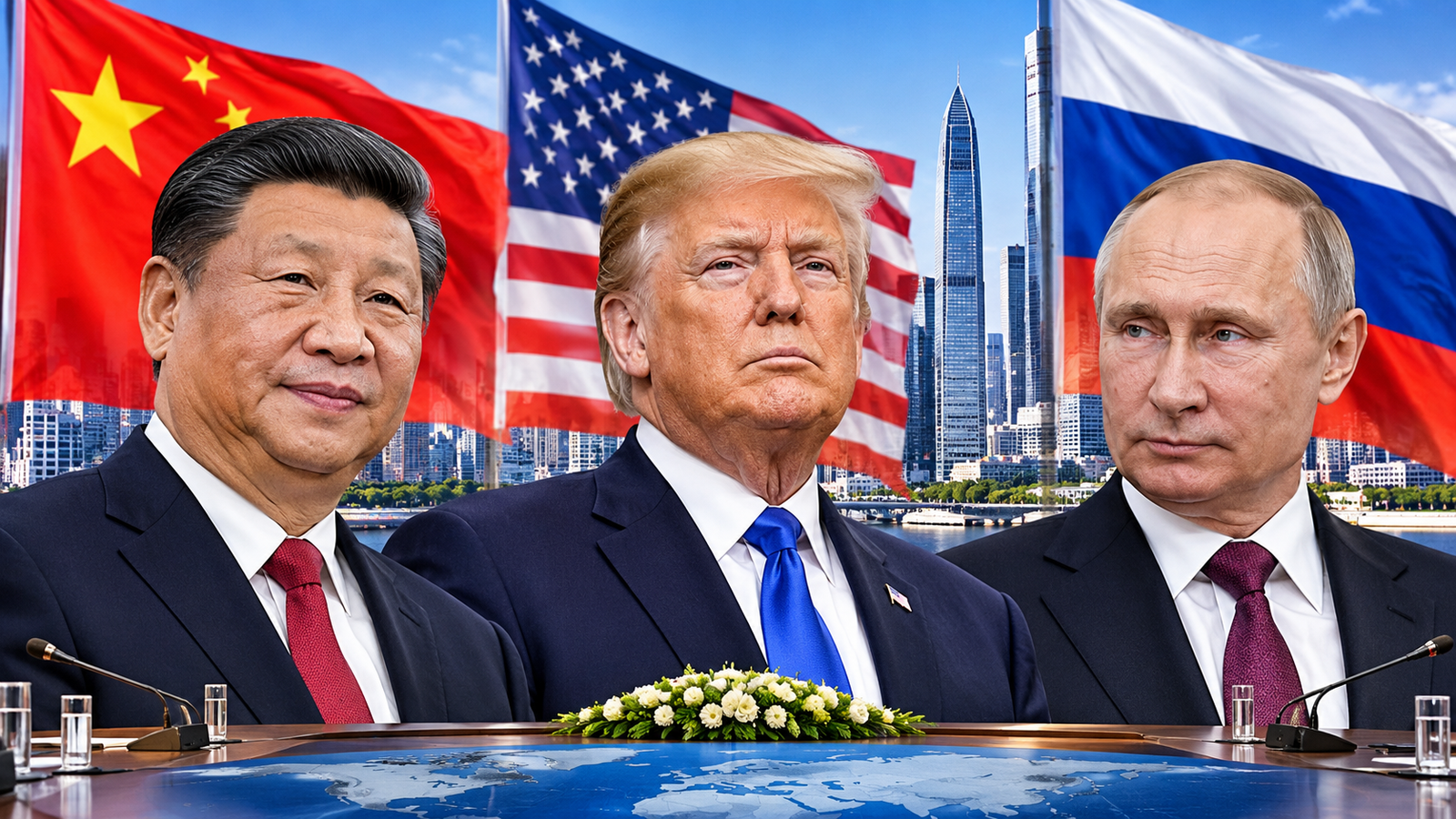
Xi, Trump and Putin Trilateral Summit in Shenzhen: What the Historic Meeting Could Mean for World Peace
Introduction
For the first time, the leaders of China, Russia and the United States are set to sit down together. The Xi Trump Putin trilateral summit is scheduled for Thursday, November 19, 2026, in Shenzhen, on the sidelines of the Asia-Pacific Economic Cooperation (APEC) gathering. Beijing confirmed the meeting on Monday and called it “ground-breaking.”
If you are trying to follow this story, you probably want clear answers to a few questions. What is actually on the agenda? Why is nuclear arms control at the centre of the conversation? What about Iran and Ukraine? And why are some governments, Kyiv most of all, worried about the meeting?
This article answers those questions in plain language. It separates what has been officially confirmed from what officials have only hinted at, and it covers the background you need to read the news with confidence. Because the summit has not yet taken place, everything here reflects the situation as of November 16, 2026, and could change.
Table of Contents
- What Is the Xi–Trump–Putin Trilateral Summit?
- Key Highlights at a Glance
- Why Shenzhen and Why APEC?
- What Will the Three Leaders Discuss?
- Denuclearisation: The Most Sensitive Item on the Table
- The Iran War: Trump’s Stated Priority
- The Ukraine Question and Why It Worries Europe (Stage 2)
- Reactions From Around the World (Stage 2)
- Pros, Cons and Risks of Three-Way Diplomacy (Stage 2)
- Frequently Asked Questions (Stage 2)
- Conclusion and Summary (Stage 2)
What Is the Xi–Trump–Putin Trilateral Summit?
The trilateral summit is a planned meeting between Chinese President Xi Jinping, US President Donald Trump and Russian President Vladimir Putin. It is expected to take place in the southern Chinese city of Shenzhen, on the sidelines of the APEC summit.
Three-way meetings among these powers are rare. Reporting around the announcement describes this as their first trilateral summit. The three countries are the world’s most heavily armed nuclear states, and they sit at the centre of several of its most serious conflicts. That is why a single shared meeting draws so much attention.
The Short Answer for Quick Readers
When: Thursday, November 19, 2026. The wider APEC meeting runs November 18–19.
Where: Shenzhen, China.
Who: Xi Jinping, Donald Trump and Vladimir Putin.
Officially stated focus: “In-depth exchanges on safeguarding world peace and promoting strategic stability in major-power relations,” according to Beijing.
How the Meeting Came Together
The idea did not appear overnight. In early September, a senior Kremlin aide said a trilateral meeting could be pursued at the Shenzhen APEC gathering. Days later, Kremlin spokesman Dmitry Peskov said a trilateral summit there was possible and that Putin and Trump had discussed the idea by phone.
Later reports described negotiations over the agenda as a major obstacle. Trump was reported to want a focus on nuclear arms control. Analysts also described Beijing as lukewarm at one stage. Then, on Monday, China’s foreign ministry confirmed the meeting. Spokeswoman Mao Ning told reporters it would be “of ground-breaking significance.”
Key Highlights at a Glance
Here are the main points to know before the leaders meet:
- A first of its kind. This is described as the first trilateral summit among the three leaders.
- China’s framing is “world peace.” Beijing says the leaders will discuss safeguarding world peace and strategic stability among major powers. It has given few other details.
- Nuclear arms control is a likely topic. Senior US and Chinese diplomats have raised the possibility that denuclearisation could come up.
- Iran is expected to feature. Trump has said the war in Iran will probably be discussed.
- Ukraine may be off the table. US officials say Trump is not expected to raise it, and Xi has reportedly pushed back on the idea of discussing it.
- Kyiv is uneasy. Ukrainian leaders fear the meeting could sideline Ukraine and Europe.
- No agreed outcomes yet. Nothing has been announced about a joint statement or any agreement.
Why Shenzhen and Why APEC?
China is hosting this year’s APEC Economic Leaders’ Meeting in Shenzhen, a high-tech southern city. APEC is a 21-economy forum, and its leaders’ week routinely draws heads of state to the same place. That makes it a natural venue for side meetings that would be hard to arrange otherwise.
A Convenient Meeting Point
An APEC summit offers three practical advantages for a meeting like this:
- All three leaders were already expected to travel there. No one has to make a separate trip to another leader’s capital.
- Meetings on the sidelines carry less formal baggage. A sideline meeting is easier to describe as informal than a standalone state visit.
- The host sets the tone. China, as host, can present itself as a convenor of major powers, which fits its stated desire to play a larger role in global diplomacy.
The Context of Recent US–China Contact
The Shenzhen meeting follows earlier contact between Washington and Beijing. Reports note that Trump met Xi on the sidelines of last year’s APEC summit in Gyeongju, South Korea. This year, a call between China’s top diplomat Wang Yi and US Secretary of State Marco Rubio laid some groundwork. According to the US State Department, the two “agreed on the importance of meaningful leader-level conversations to advance goals such as peace and denuclearisation.”
What Will the Three Leaders Discuss?
This is the central question, and the honest answer is that no full agenda has been published. China has said only that the three leaders will hold in-depth exchanges on world peace and strategic stability. Other topics come from what officials have said in public. Here is what is known.
The Official Framing: “World Peace” and “Strategic Stability”
“Strategic stability” is diplomatic shorthand for keeping relations between major nuclear powers predictable. In practice it covers reducing the risk of miscalculation, managing arms races and keeping channels of communication open. Beijing’s wording suggests a broad, high-level conversation rather than a negotiation over specific treaty text.
Topics Officials Have Signalled
Based on public statements, three topics stand out:
| Topic | Who has raised it | Current status |
|---|---|---|
| Denuclearisation and arms control | US and Chinese diplomats; Trump | Likely to be discussed, though China has resisted formal talks |
| The war in Iran | Trump | Trump says it will probably come up |
| Russia’s invasion of Ukraine | Reportedly Putin’s priority | Unlikely to be raised, according to US officials |
What Is Not Known
Several things remain uncertain. There is no confirmed joint statement, no announced deliverable and no official word on whether the three leaders will hold a single meeting or break into smaller groups. Readers should be cautious about any outlet claiming to know the outcome in advance.
Denuclearisation: The Most Sensitive Item on the Table
Of all the potential topics, nuclear arms control may be the most consequential. It is also where the three countries’ positions are furthest apart.
Why the Issue Is Urgent
A bilateral treaty between the United States and Russia limiting nuclear weapons expired in February. Afterwards, Trump called for a “better agreement” that would include China. Beijing declined to join disarmament negotiations at the time. With the old framework gone, there is no binding limit on the two largest arsenals, which is part of why the topic has returned to the top of the agenda.
The US Position
Washington has said it wants China to be part of a nuclear arms control deal. The United States is uneasy about China’s rapidly expanding nuclear arsenal. Its argument is straightforward: a three-way nuclear balance cannot be managed by a deal between only two countries.
The Chinese Position
Beijing has long maintained that the United States and Russia should first reduce their very large arsenals before China agrees to talks about its own stockpile. In simple terms, China argues that its arsenal is much smaller than those of the other two and should not be constrained until theirs come down.
This disagreement is the main obstacle. The United States wants China at the table. China wants the other two to cut first. The summit is unlikely to settle that gap on its own, but a leader-level conversation could at least show whether either side is willing to move.
The View From the United Nations
UN Secretary-General Antonio Guterres has weighed in. Speaking at an Asean summit in the Philippines on Monday, he said that if the three leaders “really commit themselves to a meaningful denuclearisation, it will be a great achievement for the world.” He added that the UN has long called for nuclear disarmament and believes the world will be “entirely safe” only when it is entirely free of nuclear weapons.
What Counts as Success?
For a reader trying to judge the summit’s outcome, these questions are useful:
- Did the three leaders agree to start formal arms control talks? Even an agreement to begin talks would be significant.
- Did China shift its position on joining negotiations? Any softening of its long-held stance would be notable.
- Did they issue a joint statement, or separate statements? Divergent readouts often signal limited agreement.
- Were there concrete steps, such as communication channels or risk-reduction measures? Smaller steps may be more realistic than a sweeping treaty.
The Iran War: Trump’s Stated Priority
The second major topic is the war involving Iran. Trump told reporters on Sunday that the leaders would discuss denuclearisation “but we’ll be talking a lot of things.” He added: “We’re trying to end the war in Iran.”
Background in Brief
The conflict was triggered by US-Israeli strikes on Tehran. The months-long crisis has at times spilled over into neighbouring countries, disrupted global shipping and pushed oil prices sharply higher worldwide. In late October, Trump said the United States had knocked out much of Iran’s military but still had to “take care of” one or two targets.
China’s Role
China is a top economic partner of Iran and has long sought to mediate. Beijing says that avoiding a return to hostilities is a “top priority.” In recent weeks it has hosted leaders and diplomats from various Middle Eastern countries to encourage the parties to return to the negotiating table.
That gives China a plausible role in the Iran discussion. As a major buyer of Iranian energy and a diplomatic player in the region, it may have channels Washington lacks. Whether Beijing is willing to use that influence in a way the United States welcomes is an open question.
Why It Matters Beyond the Region
Even readers far from the Middle East feel the effects of this conflict. Disrupted shipping lanes and higher oil prices raise costs for fuel, transport and goods. A credible path toward ending the fighting would therefore matter to ordinary households and businesses, not only to governments.
The Ukraine Question and Why It Worries Europe
Ukraine is the subject most likely to shape how this summit is judged, even if it never reaches the formal agenda.
Why Ukraine May Be a No-Go Topic
According to the information available, Russia’s invasion of Ukraine could prove off-limits in Shenzhen. A Wall Street Journal report last month said Putin wanted the three-way talks to broker a peace deal in Ukraine that would favour Moscow. Moscow launched its invasion in 2022.
The other two leaders appear unwilling to go along. US officials say Trump is not expected to raise the issue. German President Frank-Walter Steinmeier has said Xi showed “irritation” in a recent meeting when the idea of the trilateral talks covering Ukraine came up. Steinmeier told the German broadcaster ARD that Xi pointed out this is a European conflict in which Europeans must also be at the table.
Kyiv’s Concerns
That has done little to reassure Ukraine, which is anxious about being sidelined. Ukrainian President Volodymyr Zelensky has warned that the meeting could amount to a Yalta-like “redistribution of spheres of influence” for the 21st century.
The comparison has real historical weight. At the Yalta summit in 1945, US President Franklin D. Roosevelt, Britain’s Winston Churchill and Soviet leader Joseph Stalin carved up new post-WWII territorial boundaries with little concern for the views of other countries. Zelensky’s point is that major powers should not settle questions affecting smaller states without those states present.
Ukraine’s Foreign Minister Andriy Sybiha went further. He said a meeting between the US, Chinese and Russian leaders would “only encourage Putin to continue this war.”
The Wider Diplomatic Picture
Trump’s willingness to meet Putin is also part of a longer pattern. It is the latest effort to end the international isolation of Russia that followed its invasion. Supporters of engagement argue that talking to adversaries is the only route to ending wars. Critics counter that high-level meetings can reward an aggressor without extracting concessions. Both arguments are widely made, and the summit’s outcome will give each side new evidence.
One analysis from Al Jazeera framed it this way: analysts say a Trump–Xi–Putin meeting would be a coup for Moscow, but Beijing appears lukewarm. That view captures the unevenness of interests. Russia gains visibility, while China may prefer to keep the meeting’s scope narrow.
Reactions From Around the World
Reaction so far falls into three broad camps.
Supportive or Hopeful
The UN Secretary-General’s comments are the clearest example. Guterres tied the summit to a long-standing UN call for nuclear disarmament and described a real commitment to denuclearisation as a “great achievement for the world.” Beijing and the US State Department have also used positive language about leader-level conversations on peace and denuclearisation.
Cautious
Some governments and analysts are waiting to see whether anything concrete emerges. China has not published a detailed agenda, and the nuclear positions of Washington and Beijing remain far apart. Without a clear deliverable, a summit can produce warm statements and little else.
Concerned
Ukraine is the most vocal here, but European concern runs deeper. Xi’s reported remark that Europeans must be at the table on Ukraine suggests that even Beijing sees the problem of excluding them. For European governments, any impression that decisions about the continent’s security are being made elsewhere is politically sensitive.
Pros and Cons of Great-Power Summitry
Whether this summit is a good idea depends on who you ask. A balanced reading of the arguments looks like this.
| Potential benefits | Potential risks |
|---|---|
| Direct leader-to-leader contact can reduce misunderstanding between nuclear powers | Smaller countries may feel excluded from decisions that affect them |
| Creates an opening for arms control talks after the expiry of the US–Russia treaty | A meeting without results may raise expectations that are then disappointed |
| May help coordinate on ending the Iran war and easing pressure on shipping and oil prices | Could be portrayed as granting Russia legitimacy while its invasion continues |
| Shows that rival powers can still talk | Differences over Ukraine and nuclear limits may deepen rather than narrow |
These lists are not predictions. They are the considerations that diplomats and commentators most often raise, and the real outcome may fall anywhere between them.
Who Should Follow This Story Closely?
This summit is relevant well beyond foreign-policy specialists.
- Energy and shipping professionals. Any progress on the Iran war could affect oil prices and shipping routes.
- Students of international relations. It is a live case study in nuclear arms control, great-power rivalry and the role of host countries.
- Residents of Europe and Ukraine. The question of who gets a say in European security is central.
- General readers. Nuclear policy and global stability affect everyone, even when the effects are indirect.
Anyone looking for quick conclusions should be careful. The summit has not yet happened, and early claims about its outcome should be treated cautiously.
Common Mistakes When Reading Summit Coverage
- Treating announcements as agreements. A confirmed meeting is not a deal. Wait for official joint statements.
- Assuming every leader shares the same agenda. China, Russia and the United States each emphasise different priorities.
- Relying on a single source. Compare official readouts from all three governments, plus independent reporting.
- Ignoring the third parties. Ukraine, European governments and the UN are all part of the story.
Frequently Asked Questions
When is the Xi–Trump–Putin summit?
It is scheduled for Thursday, November 19, 2026, in Shenzhen, on the sidelines of the APEC summit, which runs November 18–19.
Is this really the first trilateral summit among the three leaders?
Reporting around the announcement describes it as the first such meeting. Beijing has called it “ground-breaking.”
Will Ukraine be discussed?
It is uncertain. Reports say Putin wanted the talks to address Ukraine, but US officials say Trump is not expected to raise it, and Xi has reportedly resisted. Ukraine is not officially on China’s stated agenda.
Why is nuclear arms control on the agenda?
A bilateral US–Russia nuclear treaty expired in February. Washington wants China included in a new deal, while Beijing says the two larger arsenals should shrink first. The summit offers a rare chance for leaders to discuss that gap directly.
Could the summit produce an agreement?
Nothing has been announced. The leaders could issue statements, agree to further talks or conclude without a joint outcome. Readers should wait for official announcements.
Conclusion
The Xi Trump Putin trilateral summit is significant mainly because of who will be in the room. Three leaders with major influence over nuclear policy, energy markets and European security will meet together for the first time. China frames the talks around “world peace” and strategic stability. In practice, the likeliest topics are nuclear arms control and the war in Iran, with Ukraine a politically charged subject that may be avoided.
Whether the summit delivers anything concrete is unknown. The US and China remain far apart on nuclear talks, and Ukraine and its European allies fear being left out. The most useful approach is to follow official statements from all sides, treat early speculation with caution, and judge the result by what is actually agreed rather than what is promised.
Summary
China, Russia and the United States are set to hold their first trilateral summit in Shenzhen on November 19, on the sidelines of APEC. Beijing says the leaders will discuss world peace and strategic stability. Nuclear arms control is expected to feature after the expiry of the US–Russia treaty in February, though the US and China disagree on how to proceed. Trump says Iran will also come up. Ukraine may be avoided, and Kyiv fears being sidelined. No agenda or outcome has been confirmed, so readers should await official statements.