Khyber Pakhtunkhwa Education City Plan: What the Governor’s Development Review Means for Designated Districts
Introduction
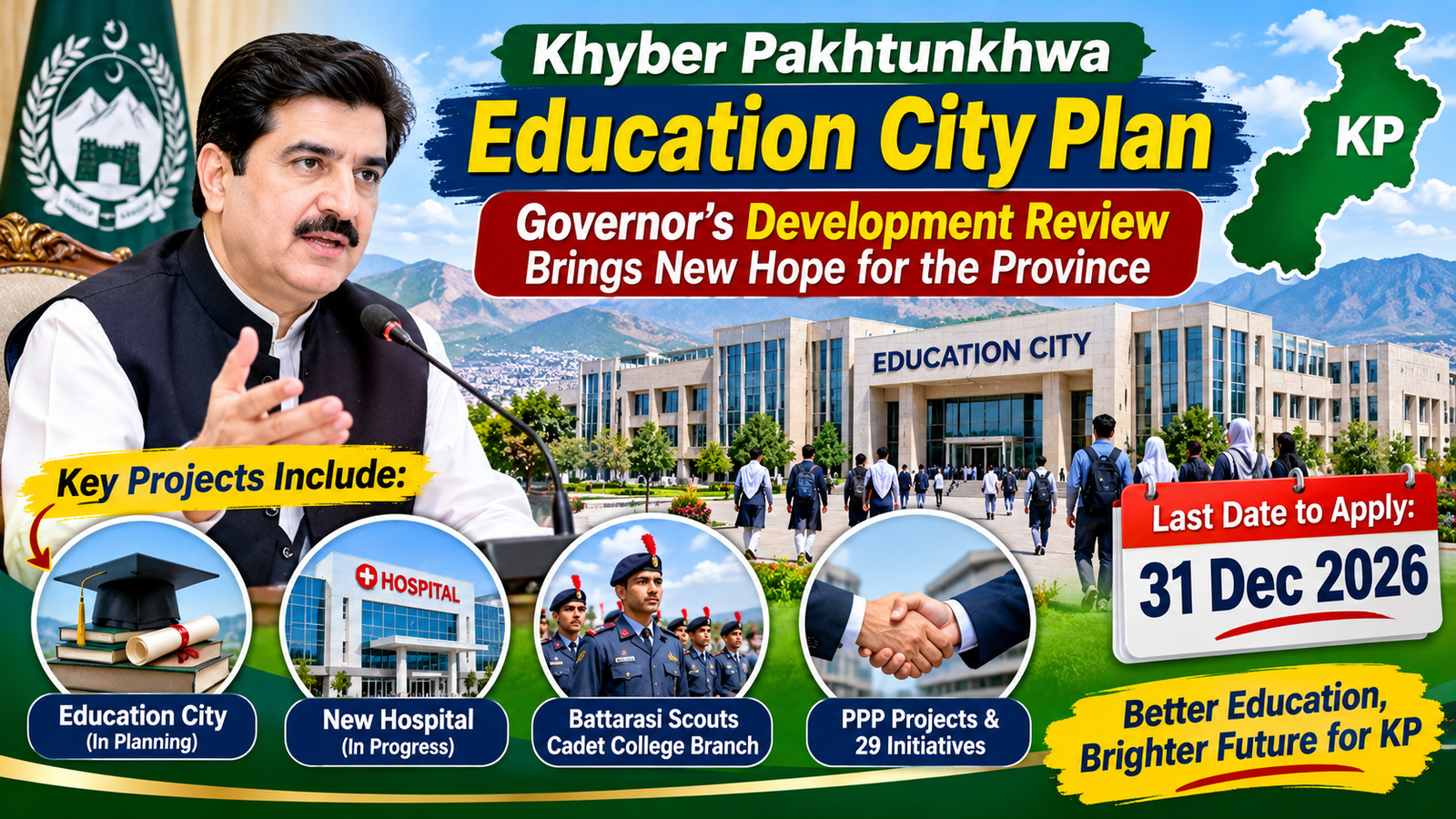
Khyber Pakhtunkhwa Governor Faisal Karim Kundi has announced that planning is under way to establish an “education city” in designated districts. The aim is to promote higher education and give young people better access to research and modern learning. For students, parents and teachers in the province, the key questions are what this means, how far the plan has progressed and what else is on the development agenda.
The announcement came during a review meeting on ongoing and proposed projects under the Area Development Secretariat (ADS). The same discussion covered a planned hospital, a new branch of the Battarasi Scouts Cadet College, and short-term development targets. A separate meeting on public-private partnerships (PPPs) took up transparency and the proposed KP Public-Private Partnership Authority Bill.
This article explains the Khyber Pakhtunkhwa education city plan and the wider development push around it. It separates what officials have confirmed from what is still at the planning stage. It is based on an official statement about the meetings, so many details, such as locations, costs and timelines for the education city, have not yet been made public.
Table of Contents
- Overview: What Was Announced
- Key Highlights at a Glance
- Understanding the Area Development Secretariat and Designated Districts
- What Is the Proposed Education City?
- Why Higher Education and Research Matter for Designated Districts
- Healthcare Plans: The Proposed Hospital
- Battarasi Scouts Cadet College Branch
- The 100-Day and 180-Day Targets
- The Accelerated Implementation Programme (AIP)
- What We Know and What Remains Unclear
Overview: What Was Announced
The governor spoke on Monday at a review meeting on the progress of ongoing and proposed development projects under the ADS, according to an official statement. Before he spoke, the additional chief secretary of the ADS, Yahya Akhunzada, briefed him on the status of current and planned projects, the progress achieved so far and the future roadmap. Senior officials from relevant departments also attended.
The governor made three main points:
- Planning is under way for an education city in designated districts, intended to promote higher education and offer better research and modern learning opportunities.
- The development of designated districts is among the government’s top priorities.
- Development projects need effective implementation so that people get basic facilities and a better quality of life.
The statement does not say where the education city will be built, how large it will be, how it will be funded or when it will open. Those points are best treated as unanswered until officials publish more information.
Key Highlights at a Glance
| Area | What the official statement says |
|---|---|
| Education city | Planning under way in designated districts to promote higher education, research and modern learning |
| Healthcare | Work in progress on establishing a hospital in designated districts |
| School-level education | A branch of the Battarasi Scouts Cadet College will be set up |
| Targets | ADS briefed on its 100-day and 180-day development targets |
| Programme | Briefing on the Accelerated Implementation Programme (AIP) |
| Sectors covered | Health, education, socio-economic development, security, infrastructure and other key areas |
| Governor’s directive | Effective, timely implementation of development projects |
Understanding the Area Development Secretariat and Designated Districts
What is the Area Development Secretariat?
The Area Development Secretariat is the government body whose projects were reviewed at the meeting. The statement describes it as handling ongoing and proposed development projects, and its senior officials briefed the governor on their progress. The statement says little about its legal structure or mandate, so this article does not describe those in detail.
What are “designated districts”?
The statement uses the phrase “designated districts” without naming them. It does say that the districts are a priority for the government and that the projects there cover health, education, socio-economic development, security and infrastructure. Readers who want to know whether a particular district is included should check official notifications or the provincial government’s announcements.
Why the focus on basic facilities?
The governor stressed that development projects should provide basic facilities and improve people’s quality of life. That is a useful test for any project: a hospital, a college or an education city matters to residents only if it is built on time, staffed properly and accessible to the people it is meant to serve.
What Is the Proposed Education City?
The concept in simple terms
An education city is generally a planned cluster of educational institutions in one area, often sharing facilities such as libraries, laboratories, student housing and research centres. The idea is to bring institutions together so that students and researchers can use shared resources and work across disciplines.
The official statement does not give a detailed design for the Khyber Pakhtunkhwa project. What officials have said is that it is intended to promote higher education and provide better opportunities for research and modern learning for youth. Anything beyond that, including which universities or colleges might be involved, is not yet confirmed.
What an education city could include
The following examples show what education cities elsewhere often contain. They are illustrations only, not confirmed features of this project:
- University campuses or branch campuses
- Research and innovation laboratories
- Technical and vocational training institutes
- Shared libraries, digital learning centres and student housing
- Sports and recreational facilities
Questions that remain open
Before the plan can be judged, the public will want to know several things:
- Location: Which district or districts will host it?
- Institutions: Will existing universities expand there, or will new ones be established?
- Funding: Will it be publicly funded, privately funded or a mix?
- Timeline: When will construction begin, and when will the first students enrol?
- Access: How will students from remote or underserved areas benefit?
The governor’s later remarks on public-private partnerships suggest that private participation may be part of the broader development approach. The statement does not say whether it will apply to the education city.
Why Higher Education and Research Matter for Designated Districts
Access to opportunity
Young people in areas with few higher education institutions often have to travel long distances or relocate to major cities to continue their studies. The cost can put university out of reach for many families. An education city could reduce that burden if it is accessible and affordable, though that depends on how it is designed and run.
Research and modern learning
The governor specifically mentioned research and modern learning. Research capacity can help a region by training skilled graduates, supporting local industry and generating practical solutions to local problems in areas such as agriculture, health, energy and tourism. These benefits are potential outcomes and depend on funding, faculty and institutional quality.
The connection to broader development
The meeting was framed around improving quality of life, not education alone. Education, healthcare, security and infrastructure are connected: a good university needs reliable roads, safe surroundings and healthcare nearby to attract students and teachers. The wide range of sectors in the briefing, from health to security to infrastructure, reflects that connection.
Realistic expectations
Large education projects can take years from planning to opening, and plans can change as funding, land and approvals are worked out. Residents and observers should treat the announcement as an early planning milestone, not a guarantee of an opening date. Public updates on budgets, land acquisition and timelines will show how the project is progressing.
Healthcare Plans: The Proposed Hospital
What the governor said
During the meeting, Mr Kundi said work was in progress on establishing a hospital to improve the quality of healthcare facilities in designated districts. The statement gives no details about the hospital’s size, specialties, location or opening date.
Why a hospital matters
In many remote or less-developed districts, patients have to travel considerable distances for specialist care or emergency treatment. A well-equipped hospital can shorten those journeys and improve outcomes. A hospital building alone does not guarantee better care, however. Several factors decide whether it improves healthcare in practice:
- Staffing: Enough doctors, nurses and technicians, including specialists
- Equipment: Functioning diagnostic and treatment equipment
- Supplies: A steady supply of medicines and consumables
- Maintenance: Funding for running costs, not only construction
- Access: Roads and transport that let patients reach the facility
Possible link with the education city
Healthcare and education can reinforce each other where institutions train medical professionals and hospitals provide clinical experience. The statement does not say the hospital and the education city are connected, so this is only a possibility.
Battarasi Scouts Cadet College Branch
What was announced
The governor said that a branch of the Battarasi Scouts Cadet College would also be set up to provide quality education and professional training opportunities to young people. The statement gives no information about its location, admission process, fee structure or opening date.
Why it is relevant
Cadet colleges are residential institutions that combine academic study with discipline and co-curricular training. They can complement higher education plans such as the education city by building a pipeline of better-prepared students. For families in designated districts, a local branch could offer a new option without requiring relocation to another part of the province.
What parents and students should watch for
- Official announcements on admissions, eligibility and fees
- Details on how students from the local districts will be selected
- The timeline for the campus opening
- Information about teaching staff and facilities
Families should rely on official notifications from the college and the provincial government and be cautious about unverified social media claims or intermediaries offering “guaranteed” admissions.
The 100-Day and 180-Day Targets
What the meeting was told
The meeting was informed about the ADS’s 100-day and 180-day development targets and the measures being taken to achieve them. The statement does not list the targets themselves.
Why short-term targets matter
Short-term targets break a larger development agenda into checkable steps. They let officials and the public see whether projects are moving, and they create points at which delays can be identified and corrected. Specific targets are most useful when they are published, because the public can then check them against progress.
How to follow progress
Since the specific targets were not detailed in the statement, interested readers can:
- Watch for official updates from the provincial government and the Governor’s Secretariat.
- Check whether progress reports are shared after the 100-day and 180-day marks.
- Look for local media coverage of project sites and milestones.
- Compare any published targets with what is actually delivered.
The Accelerated Implementation Programme (AIP)
What was discussed
The governor was also briefed on the Accelerated Implementation Programme (AIP) and on development initiatives in designated districts covering health, education, socio-economic development, security, infrastructure and other key sectors.
Understanding the programme’s role
The name suggests a focus on speeding up the delivery of projects. The statement does not describe its funding, structure or rules, so it would be wrong to assume more. What it shows is that the programme sits alongside the ADS work and spans several sectors at once.
Why a multi-sector approach matters
Development in one sector often depends on progress in others:
- Schools and colleges need safe roads and reliable power.
- Hospitals need trained staff, who in turn need housing and schooling for their families.
- Economic activity depends on infrastructure and security.
A programme that looks at these sectors together can, in principle, avoid isolated projects that fail because supporting services are missing. Whether the AIP achieves this will be clear only from its results.
What We Know and What Remains Unclear
Confirmed in the official statement
- Planning is under way for an education city in designated districts.
- A hospital is being worked on for designated districts.
- A branch of the Battarasi Scouts Cadet College will be set up.
- The ADS has 100-day and 180-day development targets.
- The AIP and multi-sector initiatives in designated districts were discussed.
- The governor stressed timely completion and effective implementation.
Not yet specified
- Names and locations of the designated districts involved
- Project costs, funding sources and budgets
- Construction schedules and opening dates
- Details of the education city’s design, institutions and admissions
- The content of the 100-day and 180-day targets
Treating these as open questions keeps expectations realistic. As officials release more information, a clearer picture will emerge of how these plans will work in practice.
The Public-Private Partnership Meeting: A Second Track of Development
The governor chaired a second meeting on public-private partnership (PPP) projects. It ran alongside the Area Development Secretariat review and covered how the provincial government hopes to use private-sector participation in development.
Who attended
The adviser to the governor on planning and development, Usman Saifullah Khan, attended the meeting. So did the chief secretary, Dr Mohammad Fakhare Alam Irfan, and the additional chief secretary for planning and development, Islamzeb, along with other senior officials.
What the governor emphasised
According to the official statement, Mr Kundi stressed three things:
- Transparency in how projects are awarded and run
- Effective monitoring during implementation
- Timely completion of projects
He said greater private sector participation would accelerate development and improve public service delivery in the province.
What Is the Proposed KP Public-Private Partnership Authority Bill?
The briefing
The meeting received a detailed briefing on the proposed KP Public-Private Partnership Authority Bill, covering its organisational structure, mandate and powers. The statement does not give the bill’s text or say when it may be introduced, so its specific provisions cannot be described here.
What a PPP authority typically does
A PPP authority is generally a dedicated body that helps government departments plan, evaluate, procure and monitor projects delivered jointly with private companies. Its role often includes setting rules for bidding, reviewing project proposals and tracking performance. This is general background, not a description of this bill. The final law, if passed, may differ.
Why legislation matters
A clear legal framework can give investors confidence that the rules are consistent. It can also give the public a way to hold projects to account. Observers will likely look at whether the bill sets out transparent procurement procedures, how disputes are handled and how oversight works once it is published.
The 29 PPP Projects: What Officials Named
The participants were also told about progress on development projects being implemented under the PPP framework across the province. Officials informed the meeting about 29 projects, and the statement names three:
| Project | Location (as stated) | Sector |
|---|---|---|
| Integrated tourism zone | Ghanool, Mansehra | Tourism |
| Boyun Kalam Ski Resort | Not specified in the statement | Tourism |
| Rashakai Economic Zone | Not specified in the statement | Industry and economic development |
The statement does not name the other 26 projects, and it does not give progress figures, investment amounts or completion dates for any of them.
Why tourism and economic zones feature
Tourism and industrial zones are common choices for PPPs because they can attract private capital and generate revenue. They can also create local jobs and business opportunities. Those are possible benefits, not confirmed outcomes, and their size depends on project design, infrastructure, security and management.
How the Two Meetings Connect
The two meetings dealt with different topics, but they share a theme: delivering projects faster and with more accountability.
- The ADS review focused on projects in designated districts, including the education city, a hospital and a cadet college branch.
- The PPP meeting focused on a framework for private participation across the province.
The statement does not say that PPP financing will be used for the education city, the hospital or the cadet college. Readers should avoid assuming a link that officials have not confirmed. The governor’s comments suggest, however, that private-sector involvement is a policy direction the government wants to encourage more broadly.
Benefits and Potential Challenges
Potential benefits
- Wider access to education and healthcare in districts that have had fewer facilities
- Research and skills development if the education city is built and staffed well
- Faster project delivery where private partners bring capital and management capacity
- Clearer rules if the PPP bill creates consistent procedures and oversight
- Local economic activity around tourism and economic zones
Potential challenges
- Limited public detail at this stage on costs, timelines and locations
- Delivery risk, as large projects often face delays in land, funding and approvals
- Staffing and running costs, which matter as much as construction for hospitals and colleges
- Oversight, since PPPs need strong monitoring to protect the public interest
- Affordability, because private involvement can affect fees and access if not managed carefully
Pros and cons at a glance
| Pros | Cons |
|---|---|
| Education, healthcare and economic projects are being prioritised for designated districts | Key details on the education city are not yet public |
| Short-term targets (100 and 180 days) support progress tracking | The targets themselves were not published in the statement |
| Governor stressed transparency and timely completion | Commitments need to be matched by visible results |
| A PPP authority could bring structure to private investment | The bill is still proposed, and its final form is uncertain |
Who Should Follow These Developments Closely?
Students and parents
Families in designated districts should watch for official announcements about admissions, eligibility and fees for the cadet college branch and any education city institutions. Always confirm details through official channels.
Teachers and researchers
Faculty and researchers may want to follow how the education city’s research mandate is defined, which institutions are involved and what facilities are planned.
Local businesses and investors
Entrepreneurs and investors may find the PPP framework relevant. Anyone considering a commitment should wait for official documents and seek professional legal and financial advice. Nothing in the statement guarantees any investment outcome.
Journalists and civic groups
Public updates on the 100-day and 180-day targets and on the PPP bill offer natural points for monitoring and reporting.
Practical Tips for Following Official Updates
- Rely on primary sources. Official statements from the Governor’s Secretariat, the Area Development Secretariat and provincial departments are the most reliable.
- Check dates. Plans change, so confirm that information is current.
- Separate plans from completed work. “Planning is under way” is different from “approved,” “funded” or “under construction.”
- Be cautious with intermediaries. No one can legitimately promise guaranteed admission, jobs or contracts linked to these projects.
- Look for published figures. Budgets, timelines and tender notices give the clearest picture of real progress.
Common Mistakes to Avoid
- Treating a planning announcement as a final decision. The education city is in the planning stage.
- Assuming locations that have not been named. The designated districts and the education city site were not specified in the statement.
- Believing unofficial admission or job offers. Use only official channels.
- Mixing up the two meetings. The ADS review and the PPP meeting covered different subjects.
- Repeating unverified numbers. The only figure given in the statement for PPP projects is 29.
Frequently Asked Questions
What is the Khyber Pakhtunkhwa education city?
It is a proposed project that the governor said is being planned in designated districts to promote higher education and provide better research and modern learning opportunities for youth. Details such as location, institutions and funding have not been announced.
Where will the education city be built?
The official statement does not say. It refers only to “designated districts,” which were not named.
Is a new hospital being built in the designated districts?
The governor said work is in progress on establishing a hospital to improve healthcare facilities in the designated districts. Its size, location and opening date were not given.
What is the Battarasi Scouts Cadet College branch?
The governor said a branch of the Battarasi Scouts Cadet College will be set up to give young people quality education and professional training opportunities. Admission details have not been announced.
Which PPP projects were mentioned?
Officials informed the meeting about 29 projects. The statement names an integrated tourism zone at Ghanool in Mansehra, the Boyun Kalam Ski Resort and the Rashakai Economic Zone.
Conclusion
The governor’s review meetings point to a development agenda that combines education, healthcare and private investment. The education city is the most ambitious educational proposal in the statement, but it is at the planning stage, and the public does not yet have its location, cost or timeline. The hospital and the cadet college branch are further steps aimed at improving services in designated districts, while the proposed PPP Authority Bill and the 29 named projects show how the government hopes to draw in private participation.
The most useful way to follow these developments is to track official announcements, watch for published targets and budgets, and treat each plan as unfinished until it is funded and under way. The governor’s own emphasis on transparency, monitoring and timely completion is a fair standard by which to judge progress.
Summary
Governor Faisal Karim Kundi said an education city is being planned in Khyber Pakhtunkhwa’s designated districts to promote higher education, research and modern learning. He also said a hospital is in progress and a Battarasi Scouts Cadet College branch will be set up. The Area Development Secretariat discussed its 100-day and 180-day targets and the Accelerated Implementation Programme. A separate meeting reviewed the proposed KP Public-Private Partnership Authority Bill and 29 projects. Locations, costs and timelines for most plans remain unannounced.